How demand is changing in architectural facade and monument lighting
The requests most often arriving in architectural facade and monument lighting projects and what they say about the market.
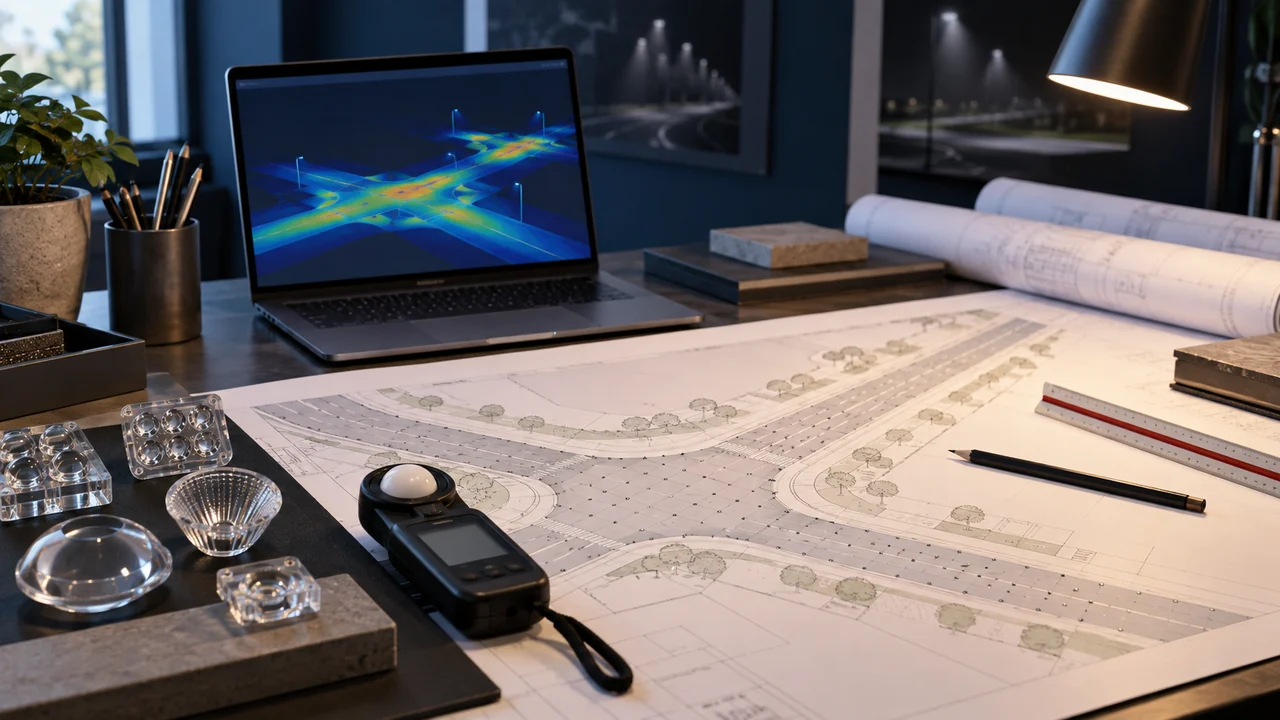
Studio illuminotecnico con planimetria, ottiche e simulazione della luce. Immagine illustrativa generata con AI.
Overview
The requests reaching the technical office are a reliable indicator of how the market is changing. Architectural lighting enhances built heritage but is also one of the applications most exposed to criticism for spill light and unnecessary consumption. This note summarises the trends observed in architectural facade and monument lighting projects, with no numerical projections or sector estimates.
Applicable standards
The regulatory reference for architectural facade and monument lighting is not a single document but a coordinated set of standards covering performance, safety and environmental impact. In design practice the following documents drive the main choices.
CIE 150 — limitation of obtrusive light.
regional laws — limits on facades, hours and upward flux.
Italian Legislative Decree 42/2004 — cultural heritage protection.
What is requested most often
Three requests recur with growing frequency: complete documentation accompanying the supply, guaranteed spare-part availability over a multi-year horizon, and openness of control protocols. These shift attention from product to service and presuppose a long-term supply relationship.
What these requests indicate
They indicate that clients are internalising life-cycle cost in purchasing decisions. The practical consequence is that bid comparison shifts onto documentary and contractual elements, and that specifications must be more precise about what is required and how it will be verified.
In the specific field of architectural facade and monument lighting, the greatest sensitivity concerns lighting the surface and not the sky, with precise aiming: it is the point where clarification requests concentrate during tenders.
Implications for designers and suppliers
For designers it means devoting more space to verification criteria and required documentation; for suppliers it means organising their documentation as part of the product rather than a later formality. Centro Studi Lumeitalia makes its technical office available to review tender documents.
Recurring critical points
The difficulties that most often emerge in architectural facade and monument lighting projects are not about product selection, but about defining requirements and verifying results.
Lighting the surface and not the sky, with precise aiming.
Respecting switch-off hours set by regional rules.
Keeping luminaires invisible by day on protected buildings.
Design approach
An orderly method drastically reduces variations during works and disputes at commissioning. Three choices make the difference from the earliest stages.
Luminaires with shields, louvres and beam-cutting optics.
Time programming with reduced scenarios in deep night hours.
Discreet integration of supports and wiring agreed with heritage authorities.
Parameters to verify
Facade luminance — CIE 150 — limits by environmental zone
Spill light — regional laws — aiming and shielding
Operating hours — regional laws — night switch-off or reduction
Constraints — Decree 42/2004 — compatibility with the protected asset
Most frequent mistakes
Non-conformities found at commissioning almost always come from three causes: requirements not declared or declared without a reference standard, calculation run on idealised geometry, and an optimistic maintenance factor. All three can be avoided at zero cost during design.
Key takeaways
A architectural facade and monument lighting project holds up over time when requirements are declared, the calculation reproduces real conditions and on-site verification follows an agreed protocol. Component selection matters, but comes later: without measurable requirements even the best product delivers a result that cannot be demonstrated. Centro Studi Lumeitalia makes its technical office available to review requirements and design checks.
Methodological note: This content is written for technical information purposes by Centro Studi Lumeitalia and does not replace the lighting design or a full reading of the standards cited. Applicable performance values are those of the standards in force at design time.
Domande frequenti
Can a facade be lit top-down?+
It is the preferable solution where possible, because it drastically reduces upward spill compared with uplighting.
How late can architectural lighting stay on?+
It depends on the applicable regional law: many require switch-off or reduction after a set hour, with justified exceptions for specific assets.
Where should a architectural facade and monument lighting project start?+
From a written definition of performance requirements and verification conditions: this step drives every later choice and makes the result either disputable or defensible at commissioning.
Which documents should be requested from the supplier?+
Photometric files of the proposed luminaires, declaration of conformity, lifetime data declared per IES LM-80 with its conditions, the maintenance schedule and warranty terms.
Lumeitalia — Sistemi LED professionali
Lumeitalia è il brand di illuminazione LED professionale di Mya Tech S.r.l., azienda italiana fondata nel 2011 a Trezzano sul Naviglio (MI); il brand è attivo dal 2020.