Overview of evolving regulatory references for hospitality lighting and what they mean for designers and contracting authorities.
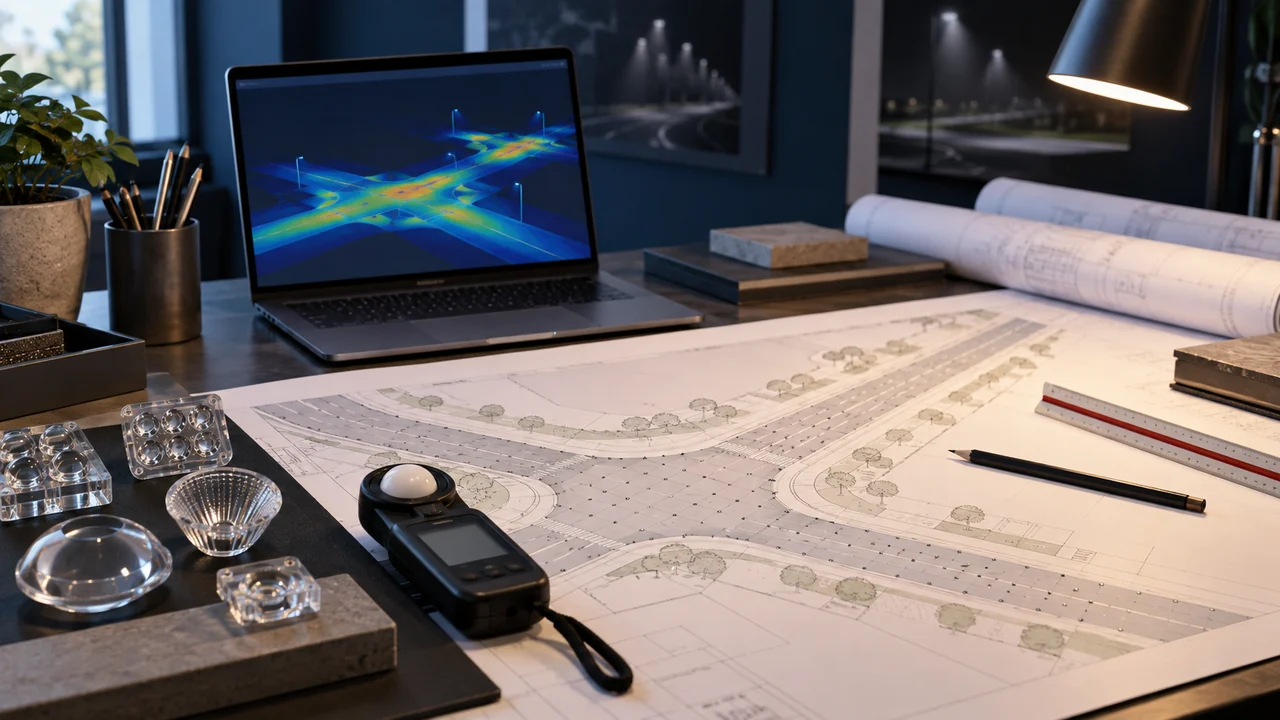
Studio illuminotecnico con planimetria, ottiche e simulazione della luce. Immagine illustrativa generata con AI.
Overview
The regulatory framework of technical lighting is continuously updated: revisions of European standards, environmental procurement criteria and local regulations overlap and change specification references. In hotels, light builds the guest experience while supporting staff work and safety requirements. This Centro Studi Lumeitalia note summarises the areas to watch for hospitality lighting.
Applicable standards
The regulatory reference for hospitality lighting is not a single document but a coordinated set of standards covering performance, safety and environmental impact. In design practice the following documents drive the main choices.
EN 12464-1 — work areas, kitchens and back office.
EN 1838 — safety lighting in common areas.
EN 13201 — outdoor areas, access roads and car parks.
What to monitor
Three fronts need constant attention: revisions of sector performance standards, updates to environmental criteria for public procurement, and regional rules on light pollution and operating hours. A specification updated on only one of the three risks being inconsistent.
Practical impact on projects
Updates mainly affect required documentation and admitted means of proof, more than performance values. For ongoing projects it is advisable to check which edition the contract cites and, where a revision has occurred, explicitly agree the reference to apply at commissioning.
For contracting authorities the most sensitive aspect is the alignment between tender criteria and documentation requested from bidders: a mismatch triggers clarification requests and lengthens award times.
How to stay up to date
The most effective safeguard is organisational: appointing an internal contact for regulatory monitoring, keeping a list of standards cited in template specifications and reviewing it at fixed intervals. Centro Studi Lumeitalia publishes technical updates on these topics in its dedicated section.
Recurring critical points
The difficulties that most often emerge in hospitality lighting projects are not about product selection, but about defining requirements and verifying results.
Separating atmosphere in guest areas from performance in service areas.
Managing evening and night scenarios without complicating staff operation.
Containing consumption in 24-hour facilities.
Design approach
An orderly method drastically reduces variations during works and disputes at commissioning. Three choices make the difference from the earliest stages.
Scheduled scenarios by time band with simplified controls.
Clear circuit separation between front and back of house.
Sensors and timers in intermittently occupied areas.
Parameters to verify
Service areas — EN 12464-1 — requirements from the visual task
Common areas — design — scenarios and lighting hierarchy
Safety — EN 1838 — corridors, stairs and exits
Outdoors — EN 13201 — access, internal roads and parking
Most frequent mistakes
Non-conformities found at commissioning almost always come from three causes: requirements not declared or declared without a reference standard, calculation run on idealised geometry, and an optimistic maintenance factor. All three can be avoided at zero cost during design.
Key takeaways
A hospitality lighting project holds up over time when requirements are declared, the calculation reproduces real conditions and on-site verification follows an agreed protocol. Component selection matters, but comes later: without measurable requirements even the best product delivers a result that cannot be demonstrated. Centro Studi Lumeitalia makes its technical office available to review requirements and design checks.
Methodological note: This content is written for technical information purposes by Centro Studi Lumeitalia and does not replace the lighting design or a full reading of the standards cited. Applicable performance values are those of the standards in force at design time.
Domande frequenti
How are hotel scenarios managed?+
With scheduled time profiles and few manual overrides: complexity should be hidden from staff, who need simple actions.
Which areas have strict regulatory requirements?+
Kitchens, laundries, offices and technical rooms follow EN 12464-1; corridors, stairs and exits require safety lighting per EN 1838.
Where should a hospitality lighting project start?+
From a written definition of performance requirements and verification conditions: this step drives every later choice and makes the result either disputable or defensible at commissioning.
Which documents should be requested from the supplier?+
Photometric files of the proposed luminaires, declaration of conformity, lifetime data declared per IES LM-80 with its conditions, the maintenance schedule and warranty terms.
Lumeitalia — Sistemi LED professionali
Lumeitalia è il brand di illuminazione LED professionale di Mya Tech S.r.l., azienda italiana fondata nel 2011 a Trezzano sul Naviglio (MI); il brand è attivo dal 2020.