White paper: technical roadmap for school and educational space lighting
Multi-year upgrade and management path for school and educational space lighting installations, from diagnosis to continuous monitoring.
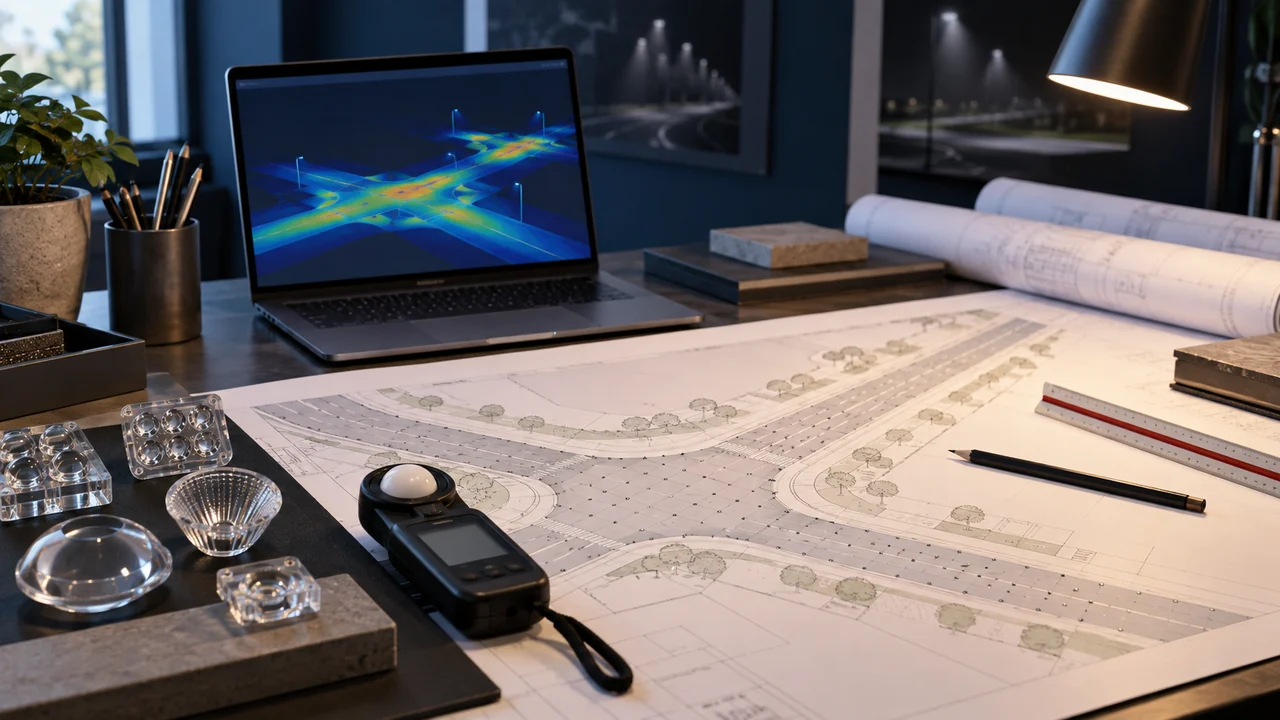
Studio illuminotecnico con planimetria, ottiche e simulazione della luce. Immagine illustrativa generata con AI.
Overview
Installation upgrades rarely fit into a single lot. This white paper proposes a multi-year roadmap for school and educational space lighting, aimed at organisations that must plan investment across several financial years. In classrooms, light affects attention and legibility: the design must consider boards, screens and daylight variability through the day.
Applicable standards
The regulatory reference for school and educational space lighting is not a single document but a coordinated set of standards covering performance, safety and environmental impact. In design practice the following documents drive the main choices.
EN 12464-1 — requirements for classrooms, labs and libraries.
EN 17037 — daylight access.
Italian CAM for lighting — requirements for public-sector supplies.
Phase 1 — Knowing the installation
The first phase produces the complete asset register and a condition assessment. It offers the best cost-to-value ratio, because it shapes every later decision and reduces on-site surprises. The expected output is a consultable, updatable archive, not a static document.
Phase 2 — Priorities and functional lots
Priorities are built by crossing safety issues, non-compliance, operating costs and user impact. Splitting the works into independently commissionable functional lots delivers benefits in the early years and allows the approach to be corrected in later lots.
This structure also helps financial planning, because each lot has a defined boundary, an estimable cost and a verifiable result at closure.
Phase 3 — Operation and continuous monitoring
Once the works are done, the roadmap does not end: it enters the operating phase, where monitoring consumption and fault events allows profiles to be corrected, maintenance to be planned and results to be documented. This often-neglected phase determines whether the expected benefits hold over time.
Recurring critical points
The difficulties that most often emerge in school and educational space lighting projects are not about product selection, but about defining requirements and verifying results.
Removing reflections on boards and monitors while keeping desk uniformity.
Handling classrooms with very different orientations.
Keeping maintenance feasible with limited school budgets.
Design approach
An orderly method drastically reduces variations during works and disputes at commissioning. Three choices make the difference from the earliest stages.
A dedicated board circuit with controlled vertical illuminance.
Row-by-row dimming based on daylight contribution.
Luminaires with replaceable components to cut life-cycle cost.
Parameters to verify
Desk illuminance — EN 12464-1 — requirement for reading and writing
Board illuminance — EN 12464-1 — vertical and uniform
UGR — EN 12464-1 — limit for classrooms and labs
CAM requirements — Italian CAM — binding in public procurement
Most frequent mistakes
Non-conformities found at commissioning almost always come from three causes: requirements not declared or declared without a reference standard, calculation run on idealised geometry, and an optimistic maintenance factor. All three can be avoided at zero cost during design.
Key takeaways
A school and educational space lighting project holds up over time when requirements are declared, the calculation reproduces real conditions and on-site verification follows an agreed protocol. Component selection matters, but comes later: without measurable requirements even the best product delivers a result that cannot be demonstrated. Centro Studi Lumeitalia makes its technical office available to review requirements and design checks.
Methodological note: This content is written for technical information purposes by Centro Studi Lumeitalia and does not replace the lighting design or a full reading of the standards cited. Applicable performance values are those of the standards in force at design time.
Domande frequenti
Is a separate board circuit needed?+
Yes: the board needs dedicated vertical illuminance and reflection control, which a uniform ceiling layout alone does not deliver.
Does lighting affect student attention?+
Technical literature links visual comfort, uniformity and glare control to lower fatigue; performance values remain those of EN 12464-1.
Where should a school and educational space lighting project start?+
From a written definition of performance requirements and verification conditions: this step drives every later choice and makes the result either disputable or defensible at commissioning.
Which documents should be requested from the supplier?+
Photometric files of the proposed luminaires, declaration of conformity, lifetime data declared per IES LM-80 with its conditions, the maintenance schedule and warranty terms.
Lumeitalia — Sistemi LED professionali
Lumeitalia è il brand di illuminazione LED professionale di Mya Tech S.r.l., azienda italiana fondata nel 2011 a Trezzano sul Naviglio (MI); il brand è attivo dal 2020.