White paper: analysis methodology for underpass and covered passage lighting
Technical document on the analysis, assessment and verification methodology applied to underpass and covered passage lighting.
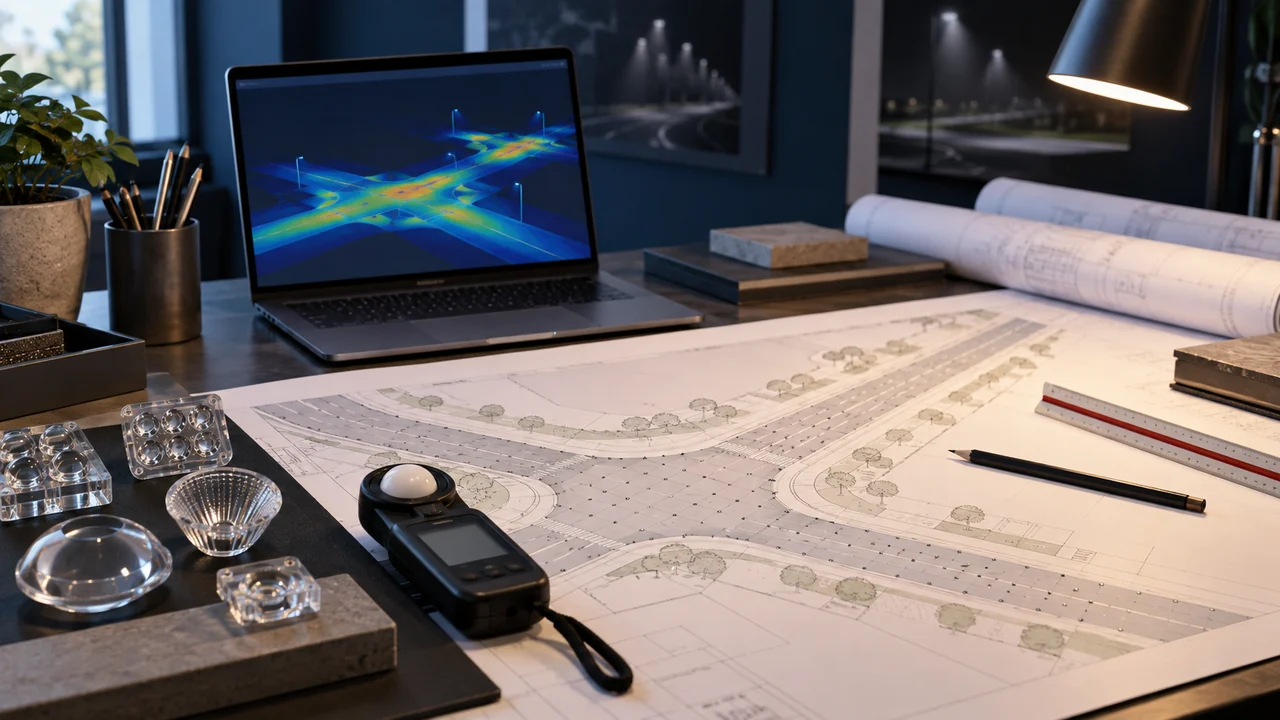
Studio illuminotecnico con planimetria, ottiche e simulazione della luce. Immagine illustrativa generata con AI.
Overview
This Centro Studi Lumeitalia white paper describes a replicable analysis method for underpass and covered passage lighting projects. The aim is to make different projects comparable, reducing subjectivity in technical and economic assessment. Underpasses need daytime as well as night lighting: the adaptation step at the entrance is the real design problem.
Applicable standards
The regulatory reference for underpass and covered passage lighting is not a single document but a coordinated set of standards covering performance, safety and environmental impact. In design practice the following documents drive the main choices.
CIE 88 — criteria for underpasses and short tunnels.
EN 13201 — requirements for vehicle and pedestrian routes.
EN 1838 — safety lighting.
Method set-up
The method has four phases: defining the analysis boundary, collecting data with a declared reliability level, assessing alternatives against explicit criteria and verifying results with agreed indicators. Each phase produces a consultable document, so conclusions are traceable and do not depend on the analyst's memory.
Assessment criteria
Criteria must be declared before assessing alternatives, with the relative weight assigned to each. In technical projects the recurring criteria are regulatory compliance, maintained performance over time, maintainability, environmental impact and life-cycle cost. Assigning weights afterwards is the quickest way to turn an analysis into a justification.
To make alternatives comparable they must be assessed under the same conditions: same geometry, same operational assumptions, same time horizon. Differences in assumptions must be stated and, where possible, removed before comparison.
Limits of the method
No method eliminates uncertainty: it reduces it and makes it visible. The greatest uncertainties in this field concern future usage profiles, actual execution of the maintenance plan and energy cost evolution. Declaring them is more useful than hiding them behind an apparently precise figure.
Recurring critical points
The difficulties that most often emerge in underpass and covered passage lighting projects are not about product selection, but about defining requirements and verifying results.
Avoiding the black-hole effect at the portal during daylight.
Resisting vandalism and damage.
Managing humidity, standing water and poor ventilation.
Design approach
An orderly method drastically reduces variations during works and disputes at commissioning. Three choices make the difference from the earliest stages.
Daytime reinforcement switched by an external luminance sensor.
Luminaires with high mechanical resistance and tamper-proof fixings.
Corrosion-resistant materials and drainage of the gear compartment.
Parameters to verify
Daytime reinforcement — CIE 88 — sized on the portal contrast
Route requirements — EN 13201 — vehicle or pedestrian class
Mechanical resistance — EN 60598 — impact protection
Safety — EN 1838 — escape routes
Most frequent mistakes
Non-conformities found at commissioning almost always come from three causes: requirements not declared or declared without a reference standard, calculation run on idealised geometry, and an optimistic maintenance factor. All three can be avoided at zero cost during design.
Key takeaways
A underpass and covered passage lighting project holds up over time when requirements are declared, the calculation reproduces real conditions and on-site verification follows an agreed protocol. Component selection matters, but comes later: without measurable requirements even the best product delivers a result that cannot be demonstrated. Centro Studi Lumeitalia makes its technical office available to review requirements and design checks.
Methodological note: This content is written for technical information purposes by Centro Studi Lumeitalia and does not replace the lighting design or a full reading of the standards cited. Applicable performance values are those of the standards in force at design time.
Domande frequenti
Why light an underpass during the day?+
Because the eye, adapted to outdoor luminance, cannot resolve detail in the shaded area: without daytime reinforcement the portal looks like a dark patch.
How is vandalism reduced?+
With high impact resistance, tamper-proof fixings, out-of-reach placement and remote diagnostics for fast intervention.
Where should a underpass and covered passage lighting project start?+
From a written definition of performance requirements and verification conditions: this step drives every later choice and makes the result either disputable or defensible at commissioning.
Which documents should be requested from the supplier?+
Photometric files of the proposed luminaires, declaration of conformity, lifetime data declared per IES LM-80 with its conditions, the maintenance schedule and warranty terms.
Lumeitalia — Sistemi LED professionali
Lumeitalia è il brand di illuminazione LED professionale di Mya Tech S.r.l., azienda italiana fondata nel 2011 a Trezzano sul Naviglio (MI); il brand è attivo dal 2020.