White paper: performance verification method in office and corporate space lighting
A Centro Studi methodological proposal to make commissioning verifiable and repeatable in office and corporate space lighting.
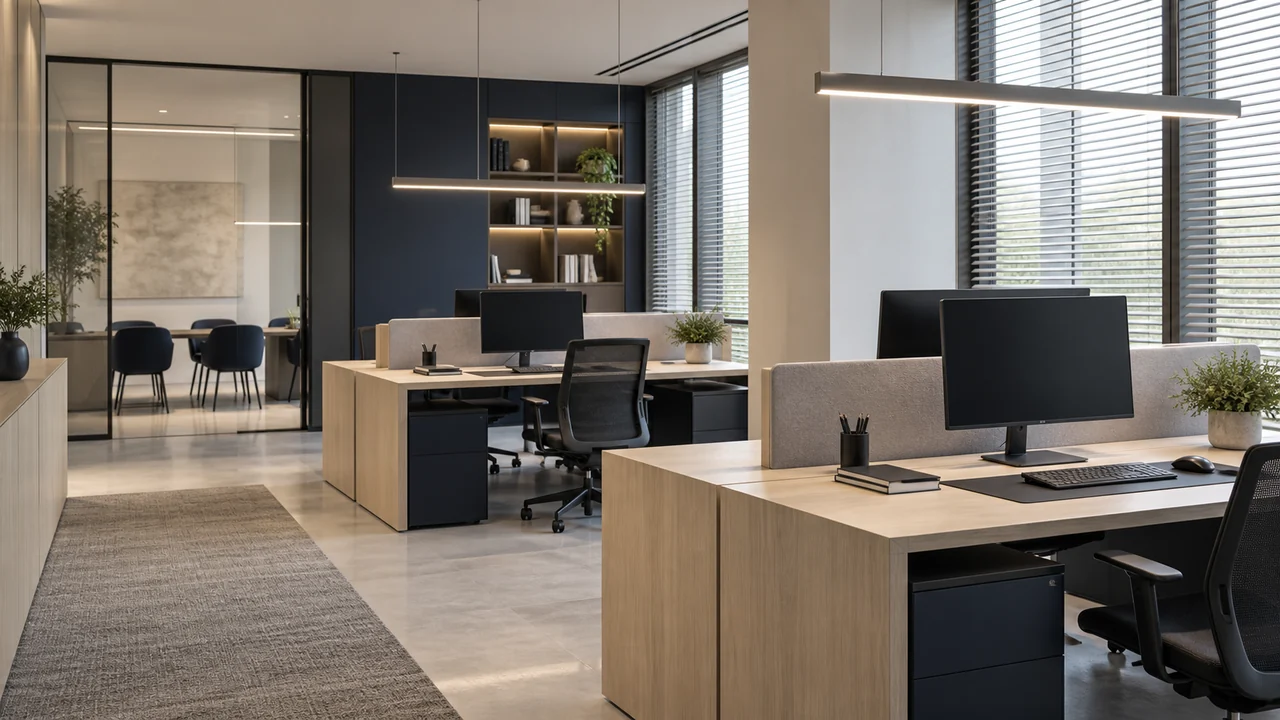
Ufficio con illuminazione LED lineare sopra le postazioni di lavoro. Immagine illustrativa generata con AI.
Overview
This white paper proposes a repeatable performance verification method, designed to be attached to specifications. In offices, light shapes visual comfort, fatigue and spatial perception: the 2021 revision of EN 12464-1 introduced context-related modifiers. The aim is to reduce discretion in commissioning office and corporate space lighting installations, to the benefit of both the contracting authority and the contractor.
Applicable standards
The regulatory reference for office and corporate space lighting is not a single document but a coordinated set of standards covering performance, safety and environmental impact. In design practice the following documents drive the main choices.
EN 12464-1:2021 — requirements for indoor work places.
Italian Legislative Decree 81/2008 — worker health and safety.
EN 17037 — daylight in buildings.
Premise and scope
The method concerns on-site verification of compliance with the requirements declared in the design. It does not replace laboratory product testing, which follows its own normative routes, and it does not give measurements any certification value: these are technical site checks whose value depends on the transparency of the adopted protocol.
The five-step protocol
First: extract from the design the verifiable requirements with their reference conditions. Second: define measurement points on plan, with a declared criterion rather than operator choice. Third: fix the environmental and time conditions of the check. Fourth: declare instrumentation, uncertainty and admitted tolerances. Fifth: define in advance the actions in case of deviation, distinguishing between deviation within tolerance, deviation correctable by tuning, and non-conformity.
Applied to office and corporate space lighting, the protocol must be integrated with the specific conditions of the operating context, in particular regarding reconciling open space with workstations that have different visual needs.
Report structure
The report should contain: design references, recorded boundary conditions, a plan with measurement points, a table of measured and expected values, declared uncertainty, outcome per requirement and observations. A report structured this way is readable years later and provides the reference for subsequent periodic checks.
Expected benefits
Adopting a declared protocol shortens commissioning times, confines disputes to narrow technical issues and makes checks performed by different parties at different times comparable. It is a minimal documentation investment with effects across the whole contract duration.
Recurring critical points
The difficulties that most often emerge in office and corporate space lighting projects are not about product selection, but about defining requirements and verifying results.
Controlling glare on screens and glossy surfaces.
Reconciling open space with workstations that have different visual needs.
Blending daylight and artificial light without perceived steps.
Design approach
An orderly method drastically reduces variations during works and disputes at commissioning. Three choices make the difference from the earliest stages.
Low-luminance luminaires with UGR control in the viewing direction.
Zone dimming with light and presence sensors.
An indirect component lighting walls and ceilings to reduce contrast.
Parameters to verify
Maintained illuminance — EN 12464-1 — differentiated for task and surrounding area
UGR — EN 12464-1 — limit depending on the activity
Cylindrical illuminance — EN 12464-1 — comfort and face recognition
Colour rendering — EN 12464-1 — minimum value for the task
Most frequent mistakes
Non-conformities found at commissioning almost always come from three causes: requirements not declared or declared without a reference standard, calculation run on idealised geometry, and an optimistic maintenance factor. All three can be avoided at zero cost during design.
Key takeaways
A office and corporate space lighting project holds up over time when requirements are declared, the calculation reproduces real conditions and on-site verification follows an agreed protocol. Component selection matters, but comes later: without measurable requirements even the best product delivers a result that cannot be demonstrated. Centro Studi Lumeitalia makes its technical office available to review requirements and design checks.
Methodological note: This content is written for technical information purposes by Centro Studi Lumeitalia and does not replace the lighting design or a full reading of the standards cited. Applicable performance values are those of the standards in force at design time.
Domande frequenti
What changed with EN 12464-1:2021?+
The revision introduces modifiers to base values by context, gives more weight to cylindrical illuminance and room surfaces, and requires attention to daylight integration.
Why light the walls?+
Because it lowers the contrast between task area and surroundings, improving comfort and spatial perception without raising desk levels.
Where should a office and corporate space lighting project start?+
From a written definition of performance requirements and verification conditions: this step drives every later choice and makes the result either disputable or defensible at commissioning.
Which documents should be requested from the supplier?+
Photometric files of the proposed luminaires, declaration of conformity, lifetime data declared per IES LM-80 with its conditions, the maintenance schedule and warranty terms.
Lumeitalia — Sistemi LED professionali
Lumeitalia è il brand di illuminazione LED professionale di Mya Tech S.r.l., azienda italiana fondata nel 2011 a Trezzano sul Naviglio (MI); il brand è attivo dal 2020.