Remote management in gymnasium and sports hall lighting: architecture and useful data
Architecture, useful data and the conditions for remote management to deliver value in gymnasium and sports hall lighting.
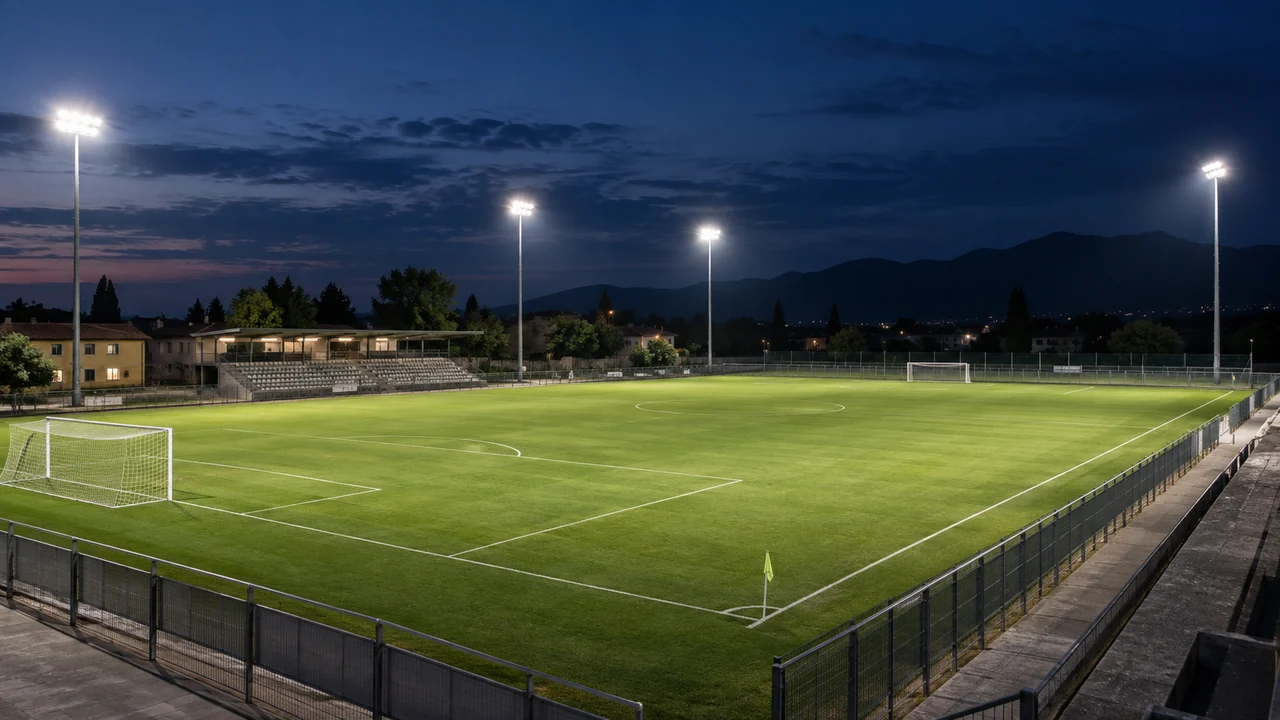
Campo da calcio illuminato da proiettori LED. Immagine illustrativa generata con AI.
Overview
Remote management delivers value only if someone uses the data it generates. Sports halls must serve different disciplines in the same volume, often with limited heights and reflective surfaces. This contribution describes the typical architecture of a remote management system applied to gymnasium and sports hall lighting and the organisational conditions that determine its usefulness.
Applicable standards
The regulatory reference for gymnasium and sports hall lighting is not a single document but a coordinated set of standards covering performance, safety and environmental impact. In design practice the following documents drive the main choices.
EN 12193 — indoor sports lighting.
EN 12464-1 — ancillary rooms, changing rooms and circulation.
EN 1838 — emergency lighting.
Typical architecture
Three layers: nodes on board the luminaire that measure and actuate, a communication layer (wired, low-power radio or cellular) and a supervision platform. The choice of communication layer depends on point density, available coverage and acceptable recurring cost. Lumeitalia's Lume-Fi ecosystem sits on this architecture with documented protocols.
Which data is actually needed
A well-instrumented installation provides operating status, energy consumed, running hours, alarms and driver operating parameters. These are enough for predictive maintenance, profile verification and energy reporting. Collecting more data than can be analysed increases transmission and storage costs without producing better decisions.
The most immediate benefit in gymnasium and sports hall lighting is fewer inspections: automatic fault reporting replaces the inspection round and cuts the time between failure and restoration.
Conditions for a return
Three organisational elements are needed: a person receiving the alarms, a procedure defining what to do when they arrive, and a periodic data review to adjust profiles. Without these, remote management remains a recurring cost. The project should include staff training and definition of operating procedures from the outset.
Recurring critical points
The difficulties that most often emerge in gymnasium and sports hall lighting projects are not about product selection, but about defining requirements and verifying results.
Avoiding direct and reflected glare for athletes looking upwards.
Protecting luminaires from ball and equipment impacts.
Managing different scenarios (training, match, event) in one installation.
Design approach
An orderly method drastically reduces variations during works and disputes at commissioning. Three choices make the difference from the earliest stages.
Luminaire layout outside the critical viewing cones of the main disciplines.
Impact grids or screens and fixings with anti-fall devices.
Preset scenarios recalled from a panel or control system.
Parameters to verify
EN 12193 class — EN 12193 — based on activity level
Glare — EN 12193 — controlled for playing and refereeing positions
Impact resistance — EN 60598 — adequate mechanical protection
Emergency lighting — EN 1838 — escape routes
Most frequent mistakes
Non-conformities found at commissioning almost always come from three causes: requirements not declared or declared without a reference standard, calculation run on idealised geometry, and an optimistic maintenance factor. All three can be avoided at zero cost during design.
Key takeaways
A gymnasium and sports hall lighting project holds up over time when requirements are declared, the calculation reproduces real conditions and on-site verification follows an agreed protocol. Component selection matters, but comes later: without measurable requirements even the best product delivers a result that cannot be demonstrated. Centro Studi Lumeitalia makes its technical office available to review requirements and design checks.
Methodological note: This content is written for technical information purposes by Centro Studi Lumeitalia and does not replace the lighting design or a full reading of the standards cited. Applicable performance values are those of the standards in force at design time.
Domande frequenti
Are separate training and match scenarios useful?+
Yes: scenarios allow lower levels during training to cut consumption, reserving full levels for competition.
How is the luminaire protected from impacts?+
With resistant grids or screens, redundant fixings and verification of the mechanical protection level for the disciplines played.
Where should a gymnasium and sports hall lighting project start?+
From a written definition of performance requirements and verification conditions: this step drives every later choice and makes the result either disputable or defensible at commissioning.
Which documents should be requested from the supplier?+
Photometric files of the proposed luminaires, declaration of conformity, lifetime data declared per IES LM-80 with its conditions, the maintenance schedule and warranty terms.
Lumeitalia — Sistemi LED professionali
Lumeitalia è il brand di illuminazione LED professionale di Mya Tech S.r.l., azienda italiana fondata nel 2011 a Trezzano sul Naviglio (MI); il brand è attivo dal 2020.