Technical scenario: new outdoor sports facility lighting installation
From requirement definition to commissioning of a new outdoor sports facility lighting installation, and the decisions that matter most.
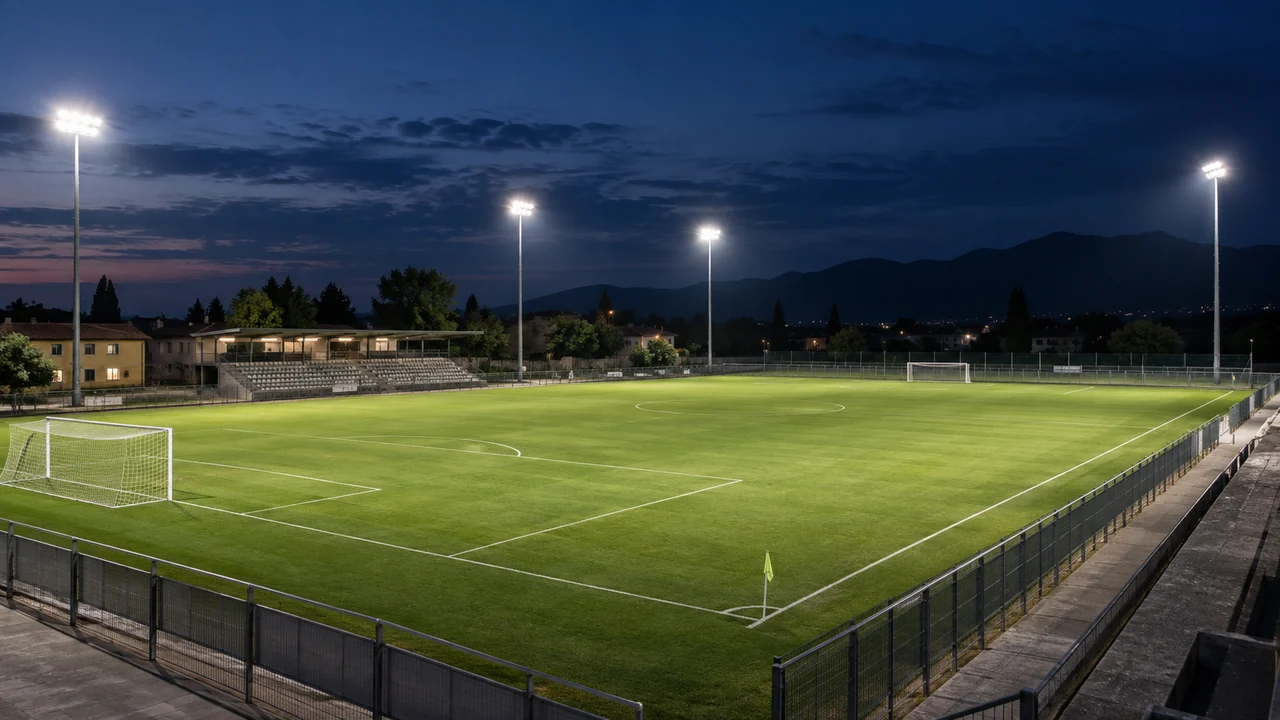
Campo da calcio illuminato da proiettori LED. Immagine illustrativa generata con AI.
Overview
In a new installation constraints are fewer and decisions weigh more: geometry, optics selection and control architecture are fixed once. Football pitches, athletics tracks and multipurpose outdoor facilities must serve athletes, spectators and, at higher levels, TV broadcasting. This methodological scenario reconstructs the typical design path of a new outdoor sports facility lighting installation.
Applicable standards
The regulatory reference for outdoor sports facility lighting is not a single document but a coordinated set of standards covering performance, safety and environmental impact. In design practice the following documents drive the main choices.
CIE 150 — obtrusive light control towards dwellings.
Defining requirements
The first decision concerns the performance level to be achieved and the standard it derives from. This is where both over-sizing — paid for over the whole installation life in energy and maintenance — and under-sizing, which surfaces at commissioning, are avoided. The requirement must be written with its reference condition: value, calculation surface or plane, and point in the installation life.
Geometry and optics selection
In a new installation geometry is a design variable, not a constraint: spacings, heights and aiming can be optimised together with the photometric distribution. Optics must be selected on real geometry, not on typical layouts. Generic distributions applied to particular geometries produce insufficient uniformity even when average values are met.
The approach that gives the best results in outdoor sports facility lighting combines aiming studies tower by tower instead of standard symmetric layouts and shielding and sharp cut-off optics towards property boundaries, assessing alternatives on annual consumption rather than installed power.
Control and commissioning
The control architecture must be decided at design stage, not added later: wiring, addressing and protocols affect conduits and switchboards. Choosing open protocols preserves freedom of action in later years and avoids being tied to a single supplier for every change.
Commissioning closes the path: agreed protocol, measurement points defined on plan, declared instrumentation, written tolerances. The same information is needed, years later, to check whether the installation is still within requirements.
Recurring critical points
The difficulties that most often emerge in outdoor sports facility lighting projects are not about product selection, but about defining requirements and verifying results.
Achieving pitch uniformity while avoiding glare for players and goalkeepers.
Controlling spill light towards neighbouring homes.
Ensuring flicker-free operation for slow-motion capture.
Design approach
An orderly method drastically reduces variations during works and disputes at commissioning. Three choices make the difference from the earliest stages.
Aiming studies tower by tower instead of standard symmetric layouts.
Shielding and sharp cut-off optics towards property boundaries.
Supply and drivers selected for flux stability under camera capture.
Parameters to verify
Lighting class — EN 12193 — I, II or III by competition level
Uniformity — EN 12193 — horizontal and vertical for broadcasting
Glare rating GR — EN 12193 — assessed for playing positions
Obtrusive light — CIE 150 — limits towards windows and sky
Most frequent mistakes
Non-conformities found at commissioning almost always come from three causes: requirements not declared or declared without a reference standard, calculation run on idealised geometry, and an optimistic maintenance factor. All three can be avoided at zero cost during design.
Key takeaways
A outdoor sports facility lighting project holds up over time when requirements are declared, the calculation reproduces real conditions and on-site verification follows an agreed protocol. Component selection matters, but comes later: without measurable requirements even the best product delivers a result that cannot be demonstrated. Centro Studi Lumeitalia makes its technical office available to review requirements and design checks.
Methodological note: This content is written for technical information purposes by Centro Studi Lumeitalia and does not replace the lighting design or a full reading of the standards cited. Applicable performance values are those of the standards in force at design time.
Domande frequenti
Which class does a municipal pitch need?+
Usually class III for training and amateur activity, class II for local and regional competitions; higher classes apply to national competition and TV coverage.
Why does flicker matter in sports venues?+
Because slow-motion capture reveals flux oscillation, so the installation is designed with stable electronics and verified under camera conditions.
Where should a outdoor sports facility lighting project start?+
From a written definition of performance requirements and verification conditions: this step drives every later choice and makes the result either disputable or defensible at commissioning.
Which documents should be requested from the supplier?+
Photometric files of the proposed luminaires, declaration of conformity, lifetime data declared per IES LM-80 with its conditions, the maintenance schedule and warranty terms.
Lumeitalia — Sistemi LED professionali
Lumeitalia è il brand di illuminazione LED professionale di Mya Tech S.r.l., azienda italiana fondata nel 2011 a Trezzano sul Naviglio (MI); il brand è attivo dal 2020.