Regulatory requirements for historic city centre lighting: what the standards ask
Structure of the standards applicable to historic city centre lighting, main requirements and verification pitfalls.
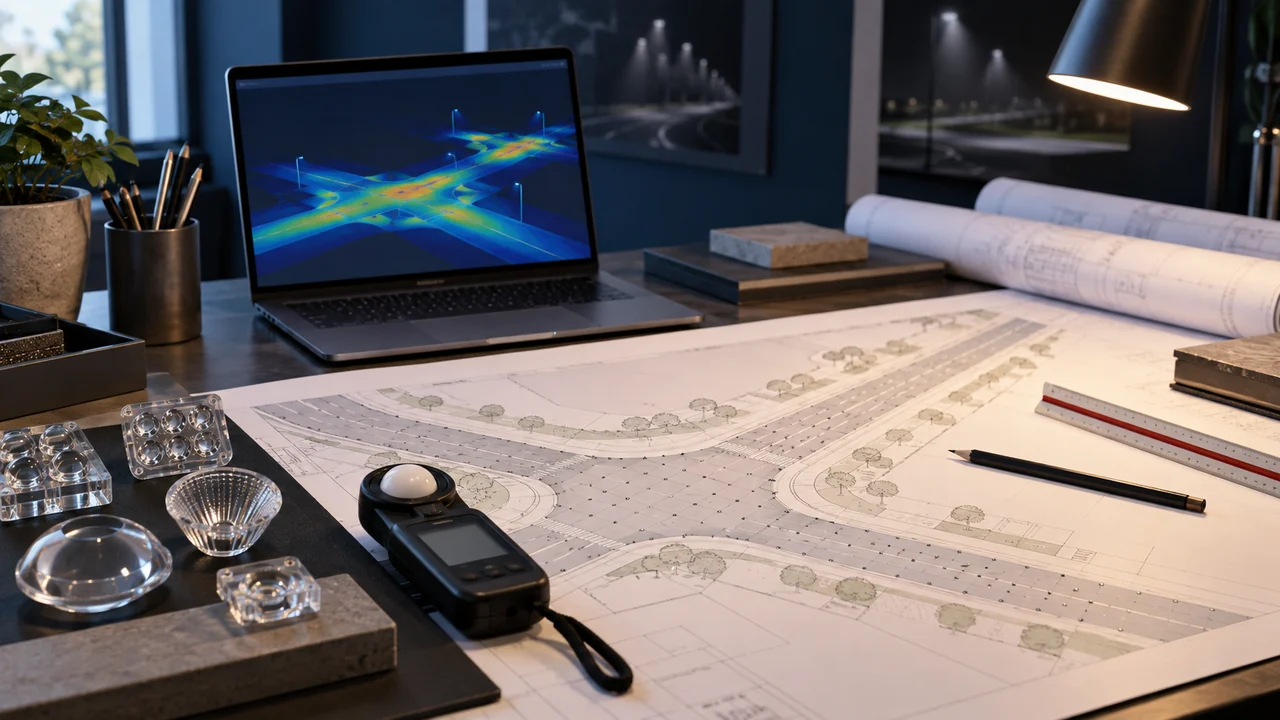
Studio illuminotecnico con planimetria, ottiche e simulazione della luce. Immagine illustrativa generata con AI.
Overview
Knowing which standard applies is the first step; understanding how its requirements are structured is what separates a compliant design from a merely complete one. In historic centres the installation must reconcile performance requirements, landscape protection and heritage constraints on luminaire appearance. This note summarises the structure of the references applicable to historic city centre lighting.
Applicable standards
The regulatory reference for historic city centre lighting is not a single document but a coordinated set of standards covering performance, safety and environmental impact. In design practice the following documents drive the main choices.
EN 13201 — performance requirements for roads and pedestrian areas.
Italian Legislative Decree 42/2004 — cultural heritage and landscape code.
regional laws — light pollution containment.
How the requirements are organised
Lighting standards generally separate three levels: classification of the field of application, performance requirements attached to each class, and the calculation or measurement methods to prove compliance. Skipping the first level is the commonest mistake: the product is chosen before the class is determined, and the design ends up justifying a decision already taken.
Demonstrating compliance
Compliance is demonstrated through the design calculation and, where required, field measurements taken with the prescribed method. Verification conditions must be documented, because the same installation can pass or fail depending on the measurement grid, maintenance status and ambient conditions. A report showing only results, without conditions, is not verifiable.
Watch out for updates: standards are periodically revised, and a specification citing a superseded edition can create misalignment between design, supply and commissioning. Citing the standard with its edition year and referring to the edition in force avoids the issue.
Interaction with other rules
Lighting requirements overlap with electrical, safety and environmental ones, plus local rules that may be stricter. In case of conflict the most severe applicable rule prevails, but the choice must be justified in the technical report to prevent later disputes.
Recurring critical points
The difficulties that most often emerge in historic city centre lighting projects are not about product selection, but about defining requirements and verifying results.
Preserving the historic night image without giving up efficiency.
Managing wall brackets, catenary suspensions and arms on protected buildings.
Avoiding colour inconsistency between successive project phases.
Design approach
An orderly method drastically reduces variations during works and disputes at commissioning. Three choices make the difference from the earliest stages.
Luminaires with a formal language consistent with the context and modern optics.
A municipal lighting plan setting colour temperatures and hierarchies.
Specifications binding colour rendering and long-term aesthetic consistency.
Parameters to verify
Lighting class — EN 13201-2 — for centre roads and pedestrian areas
Colour temperature — lighting plan — consistency across homogeneous areas
Colour rendering — specification — enhancement of historic materials
Non-conformities found at commissioning almost always come from three causes: requirements not declared or declared without a reference standard, calculation run on idealised geometry, and an optimistic maintenance factor. All three can be avoided at zero cost during design.
Key takeaways
A historic city centre lighting project holds up over time when requirements are declared, the calculation reproduces real conditions and on-site verification follows an agreed protocol. Component selection matters, but comes later: without measurable requirements even the best product delivers a result that cannot be demonstrated. Centro Studi Lumeitalia makes its technical office available to review requirements and design checks.
Methodological note: This content is written for technical information purposes by Centro Studi Lumeitalia and does not replace the lighting design or a full reading of the standards cited. Applicable performance values are those of the standards in force at design time.
Domande frequenti
Can modern luminaires be used in a historic centre?+
Yes, if the design proves formal compatibility: many projects keep the historic housing shape while upgrading optics and gear.
Which colour temperature is preferable?+
Historic contexts usually favour warm tones for continuity with the established night image, with the value fixed in the municipal lighting plan.
Where should a historic city centre lighting project start?+
From a written definition of performance requirements and verification conditions: this step drives every later choice and makes the result either disputable or defensible at commissioning.
Which documents should be requested from the supplier?+
Photometric files of the proposed luminaires, declaration of conformity, lifetime data declared per IES LM-80 with its conditions, the maintenance schedule and warranty terms.
Lumeitalia — Sistemi LED professionali
Lumeitalia è il brand di illuminazione LED professionale di Mya Tech S.r.l., azienda italiana fondata nel 2011 a Trezzano sul Naviglio (MI); il brand è attivo dal 2020.