The technical desk answers: motorway and major-artery lighting
Questions and answers with the Centro Studi Lumeitalia technical desk on motorway and major-artery lighting.
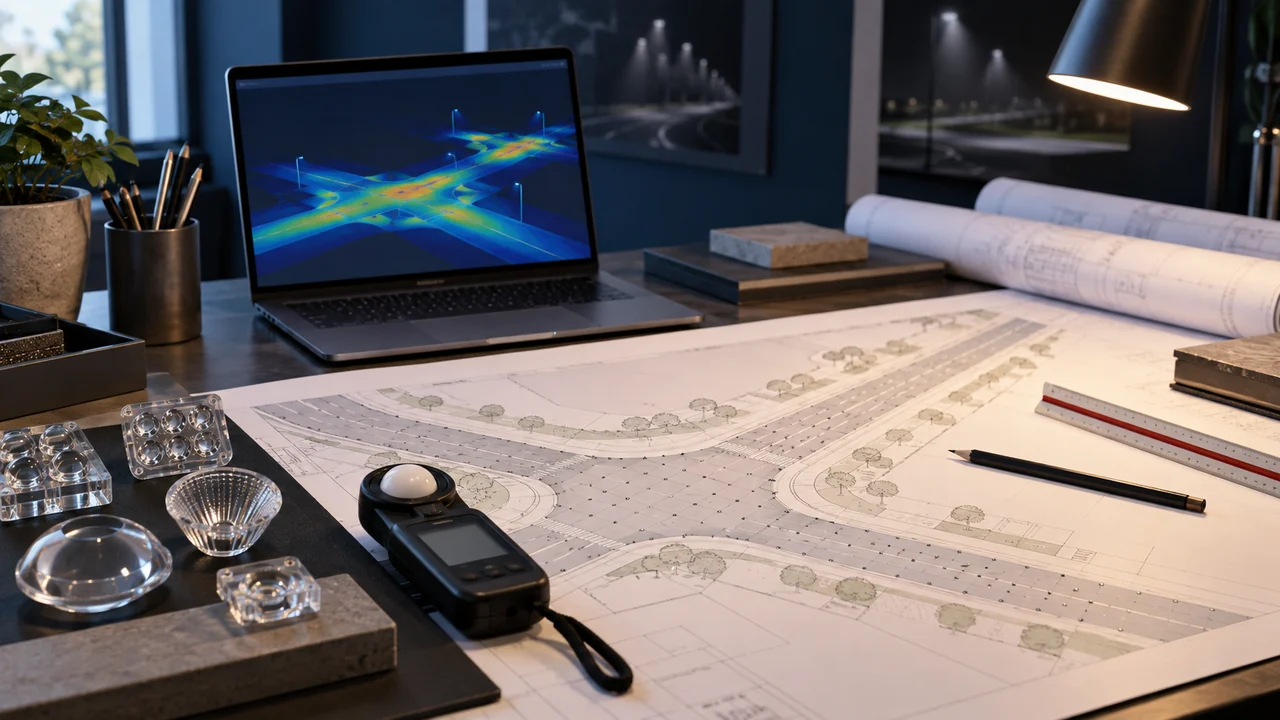
Studio illuminotecnico con planimetria, ottiche e simulazione della luce. Immagine illustrativa generata con AI.
Overview
The format of this piece is an internal technical conversation: the questions are those most often received by Centro Studi Lumeitalia from designers, technical offices and installers; the answers are drafted by the technical desk and validated by the R&D engineering office. On motorways and main extra-urban roads, lighting is concentrated on interchanges, service areas and high-risk sections, where visual continuity is a safety requirement.
Applicable standards
The regulatory reference for motorway and major-artery lighting is not a single document but a coordinated set of standards covering performance, safety and environmental impact. In design practice the following documents drive the main choices.
EN 13201-2 — M classes for fast motorised traffic.
CIE 140 — road lighting calculation methods.
UNI 11248 — class selection and adaptive downgrading.
Where does a project like this start?
You always start from the requirements, never from the product. When the luminaire is chosen before the performance class is defined, the design becomes an after-the-fact justification and problems surface at commissioning.
The recurring critical points we see in this field are well known: avoiding abrupt transition zones between lit and unlit sections; keeping maintenance feasible with minimal lane closures; withstanding vibration, de-icing salt and wind loads on high masts. These are method problems before component problems, which is why they are solved at the design set-up stage.
What is the most common mistake?
Assuming the calculated result stays unchanged over time. The maintenance factor is not a box to tick to complete the report: it embodies the assumed management of the installation. If the planned cleaning cycle is not respected, the installation drops below requirements even if the design was correct.
One practical tip for designers?
Document the assumptions as carefully as the results. In our daily work the approach that gives the most stable outcomes is this: transition zones designed with a controlled luminance gradient, luminaires with fast access to the gear tray and replaceable components and remote management for diagnostics and fewer field interventions. These three choices cost little at design stage and a great deal if postponed.
Recurring critical points
The difficulties that most often emerge in motorway and major-artery lighting projects are not about product selection, but about defining requirements and verifying results.
Avoiding abrupt transition zones between lit and unlit sections.
Keeping maintenance feasible with minimal lane closures.
Withstanding vibration, de-icing salt and wind loads on high masts.
Design approach
An orderly method drastically reduces variations during works and disputes at commissioning. Three choices make the difference from the earliest stages.
Transition zones designed with a controlled luminance gradient.
Luminaires with fast access to the gear tray and replaceable components.
Remote management for diagnostics and fewer field interventions.
Parameters to verify
M class — EN 13201-2 — assigned by design speed and complexity
Surround ratio SR — EN 13201-2 — lighting of the lateral strips
Maintainability — specification — access without removing the optic
Mechanical resistance — EN 60598 — vibration and pole loads
Most frequent mistakes
Non-conformities found at commissioning almost always come from three causes: requirements not declared or declared without a reference standard, calculation run on idealised geometry, and an optimistic maintenance factor. All three can be avoided at zero cost during design.
Key takeaways
A motorway and major-artery lighting project holds up over time when requirements are declared, the calculation reproduces real conditions and on-site verification follows an agreed protocol. Component selection matters, but comes later: without measurable requirements even the best product delivers a result that cannot be demonstrated. Centro Studi Lumeitalia makes its technical office available to review requirements and design checks.
Methodological note: This content is written for technical information purposes by Centro Studi Lumeitalia and does not replace the lighting design or a full reading of the standards cited. Applicable performance values are those of the standards in force at design time.
Domande frequenti
Why are motorways not lit end to end?+
Because continuous lighting is not always the most effective safety measure: standards and design practice concentrate it on interchanges, conflict areas, tunnels and sections with documented accident rates.
How is the transition between lit and dark sections handled?+
With a transition zone of decreasing luminance, allowing the driver's visual adaptation and avoiding the black-hole effect.
Where should a motorway and major-artery lighting project start?+
From a written definition of performance requirements and verification conditions: this step drives every later choice and makes the result either disputable or defensible at commissioning.
Which documents should be requested from the supplier?+
Photometric files of the proposed luminaires, declaration of conformity, lifetime data declared per IES LM-80 with its conditions, the maintenance schedule and warranty terms.
Lumeitalia — Sistemi LED professionali
Lumeitalia è il brand di illuminazione LED professionale di Mya Tech S.r.l., azienda italiana fondata nel 2011 a Trezzano sul Naviglio (MI); il brand è attivo dal 2020.