SOLIS NEXT: technical selection and application guide
What SOLIS NEXT is, which street lighting projects it fits, which regulatory requirements to verify and how to specify it.
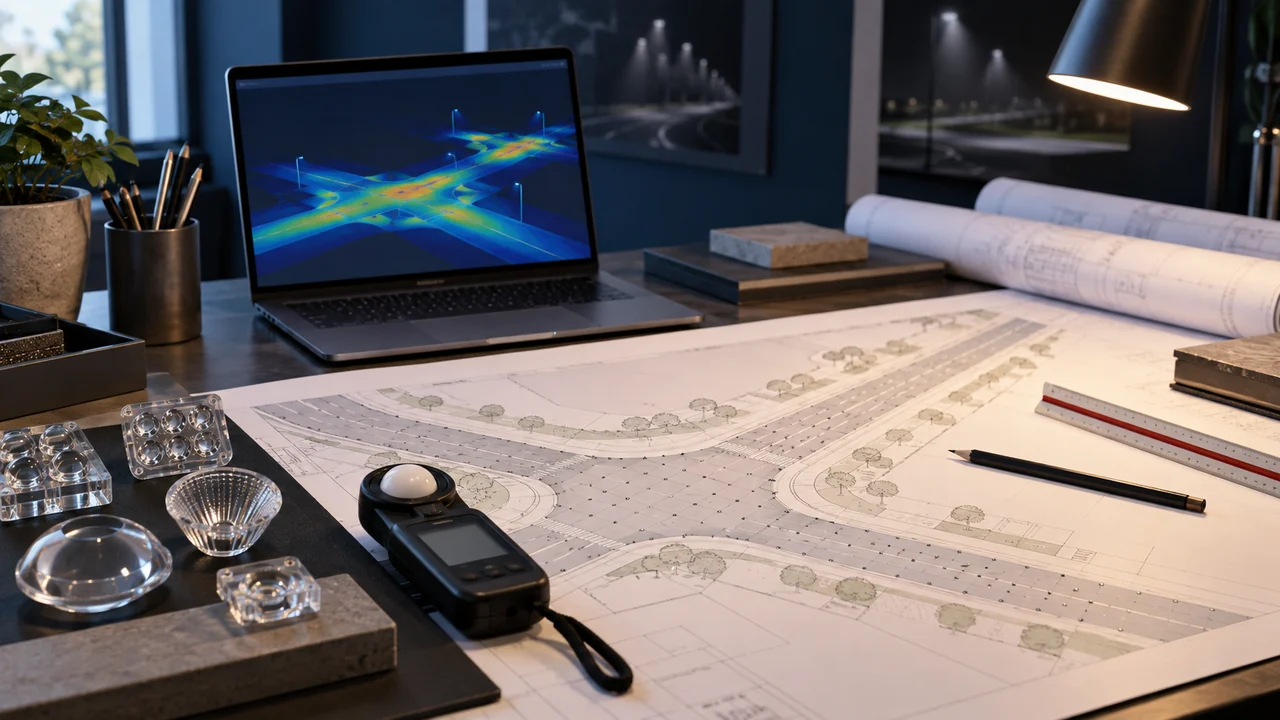
Studio illuminotecnico con planimetria, ottiche e simulazione della luce. Immagine illustrativa generata con AI.
Overview
SOLIS NEXT — Apparecchio stradale LED solare integrato. SOLIS NEXT è un apparecchio stradale LED solare integrato: pannello fotovoltaico in silicio monocristallino, batteria LiFePO4, elettronica di regolazione e moduli LED SMD5050 in un unico corpo in alluminio pressofuso. Disponibile nelle configurazioni PRO ad alte prestazioni con controller MPPT e CORE bilanciata con controller PWM, ciascuna nelle taglie S compatta e L estesa. Pensato per strade principali e secondarie, piazze, percorsi e aree prive di cablaggio di alimentazione. This Centro Studi briefing does not replace the product page: it frames the luminaire within the design process, from requirement definition to on-site verification.
Where it is used
SOLIS NEXT belongs to the street lighting scope and is used in urban and suburban roads, roundabouts, pedestrian crossings and neighbourhood streets. Three items always come first: classification of the scope under the applicable standard, the real installation geometry (spacings, heights, brackets or pitches) and the maintenance conditions planned over the installation life cycle.
Strade principali e secondarie
Piazze e aree urbane
Percorsi pedonali e ciclabili
Aree senza cablaggio di alimentazione
Build characteristics
Photometric data: Specific photometric values (flux, efficacy, expected illuminance) are not published in generic form because they depend on configuration and installation geometry. Photometric files for calculation are available from the technical office at info@lumeitalia.it.
Pannello fotovoltaico in silicio monocristallino con vetro temperato 3,2 mm ad alta trasmittanza
Vita utile del pannello oltre 15 anni
Batteria LiFePO4 integrata
Moduli LED SMD5050 con lente PC dedicata alla distribuzione stradale
Regolazione meccanica fino a 180°
Fotosensore: accensione al tramonto, spegnimento all'alba
Gestione temporizzata dei livelli di potenza
SOLIS NEXT PRO con controller MPPT 3,2V, efficienza di carica fino al 95%
Pannello fotovoltaico — Monocristallino 60 / 90 W
Efficienza conversione — 22 %
Batteria — LiFePO4 3,
2V 60 / 90 Ah
Energia batteria — 192 / 288 Wh
Sorgente — 80 / 160 LED SMD5050
CRI — >70
CCT — 3000 / 4000 / 5000 / 5700 / 6500 K
Tempo di ricarica — circa 4 (con irraggiamento sufficiente) h
Regulatory requirements to verify
The requirement must be stated before product selection and repeated at commissioning with the same measurement method. A requirement written without a reference standard and without verification conditions is the most frequent cause of dispute at acceptance.
UNI 11248 — road classification and risk analysis
EN 13201-2 — performance requirements for M, C and P classes
EN 13201-3 — performance calculation method
Scope classified under the applicable standard, with the risk analysis attached
Performance requirements stated with standard, measurement point and conditions
Maintenance factor justified and consistent with the cleaning plan
Photometric files requested from the technical office for the design calculation
Ingress protection, impact resistance and electrical class matched to the site
Dimming system and control protocol defined in the specification
Warranty terms, spare parts and maintenance accessibility
Installation, operation and maintenance
During installation the main variables are aiming, tightening of the fixings and correct execution of the electrical terminations. In operation, the maintenance plan must state the cleaning frequency of the optical surfaces, periodic gasket checks and how electronic components are replaced.
SOLIS NEXT is a defensible choice when street lighting requirements are stated, the calculation reproduces the real geometry and commissioning follows an agreed protocol. The full datasheet and quotation request are on the product page: https://lumeitalia.it/prodotti/solis-next. The technical office is available for design requirement reviews at info@lumeitalia.it.
Domande frequenti
Which projects should consider SOLIS NEXT?+
Street lighting projects covering urban and suburban roads, roundabouts, pedestrian crossings and neighbourhood streets. Suitability starts from scope classification and real geometry, not from datasheet comparison.
Which documents should be requested before specifying SOLIS NEXT?+
Photometric files for the proposed luminaires, declaration of conformity, declared lifetime data per IES LM-80 with its conditions, maintenance schedule and warranty terms.
Is SOLIS NEXT suitable for retrofitting an existing installation?+
It depends on the inherited geometry: existing spacings and heights must be checked with a dedicated calculation before confirming a one-for-one replacement. The technical office runs the check on request.
Why are photometric values not published?+
Because an out-of-context figure cannot be verified: the result depends on configuration, optic and installation geometry. Photometric files are available at info@lumeitalia.it.
Lumeitalia — Sistemi LED professionali
Lumeitalia è il brand di illuminazione LED professionale di Mya Tech S.r.l., azienda italiana fondata nel 2011 a Trezzano sul Naviglio (MI); il brand è attivo dal 2020.