Optics and thermal management applied to motorway and major-artery lighting
How photometric distribution and heat dissipation determine the real result in motorway and major-artery lighting installations.
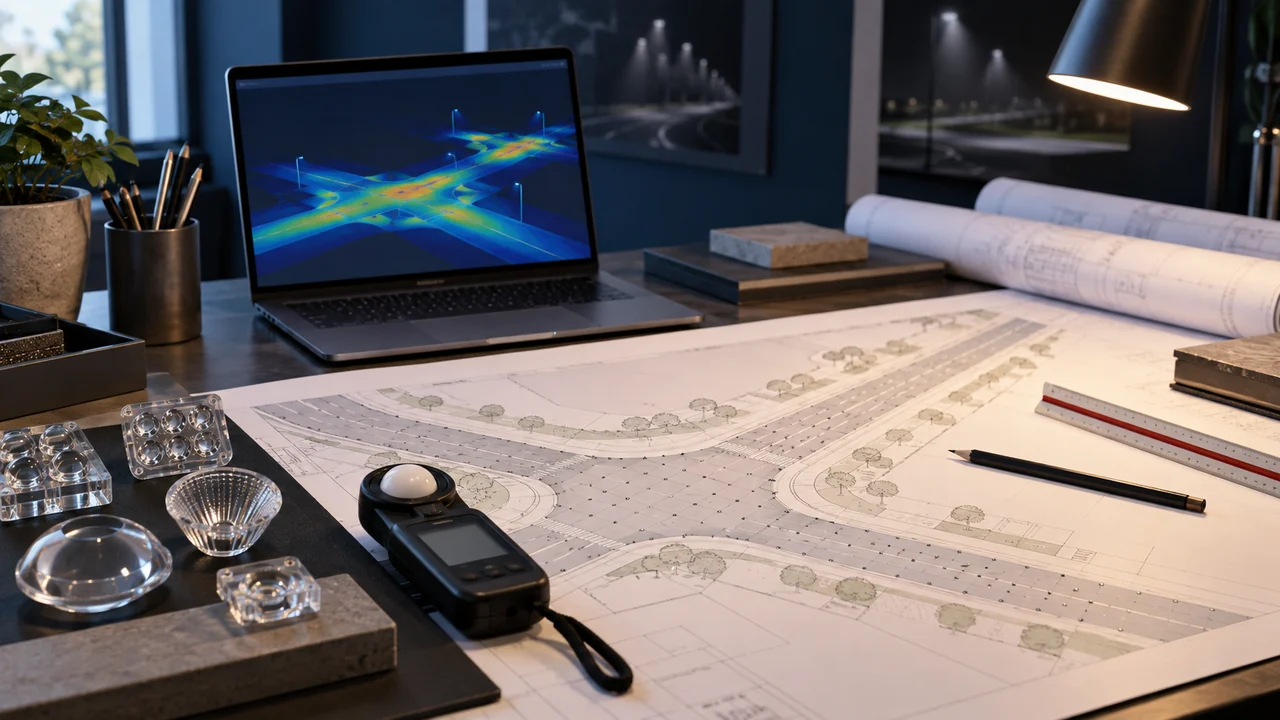
Studio illuminotecnico con planimetria, ottiche e simulazione della luce. Immagine illustrativa generata con AI.
Overview
Two luminaires with the same wattage can perform very differently in the same installation: the difference lies in photometric distribution and in how heat is removed from the LED junction. On motorways and main extra-urban roads, lighting is concentrated on interchanges, service areas and high-risk sections, where visual continuity is a safety requirement. This article analyses both aspects and their effect on installation service life.
Applicable standards
The regulatory reference for motorway and major-artery lighting is not a single document but a coordinated set of standards covering performance, safety and environmental impact. In design practice the following documents drive the main choices.
EN 13201-2 — M classes for fast motorised traffic.
CIE 140 — road lighting calculation methods.
UNI 11248 — class selection and adaptive downgrading.
Distribution matters more than wattage
The share of flux actually reaching the target surface depends on the shape of the photometric solid and how well it matches the area geometry. An unsuitable distribution wastes light where it is not needed and forces higher installed power to meet requirements, at a double cost: more energy and more obtrusive light.
Selection should therefore compare behaviour in the real geometry, not an isolated headline figure. Modular optical platforms, such as Lumeitalia's OTP® system, exist precisely to adapt distribution to the context while keeping the luminaire body unchanged.
Why thermal design determines lifetime
Junction temperature governs flux depreciation and the reliability of electronic components. An efficient thermal path keeps the junction well below declared limits even at high ambient temperatures, reducing degradation over time. Lumeitalia's Cool-X® solution, based on polymer-matrix composite filled with graphite, addresses this by focusing on conductivity and reduced luminaire mass.
In design terms, thermal behaviour boils down to two concrete questions: what ambient conditions are expected, and how the luminaire behaves when air does not circulate freely, for example because of soiling or installation in enclosed compartments.
Combined effects on the installation
Optics and thermal design interact: an efficient distribution lowers required power, lower power reduces thermal load, and lower thermal load slows depreciation. The benefit shows over time as a smaller gap between initial and maintained performance, meaning a more favourable maintenance factor and longer replacement intervals.
Recurring critical points
The difficulties that most often emerge in motorway and major-artery lighting projects are not about product selection, but about defining requirements and verifying results.
Avoiding abrupt transition zones between lit and unlit sections.
Keeping maintenance feasible with minimal lane closures.
Withstanding vibration, de-icing salt and wind loads on high masts.
Design approach
An orderly method drastically reduces variations during works and disputes at commissioning. Three choices make the difference from the earliest stages.
Transition zones designed with a controlled luminance gradient.
Luminaires with fast access to the gear tray and replaceable components.
Remote management for diagnostics and fewer field interventions.
Parameters to verify
M class — EN 13201-2 — assigned by design speed and complexity
Surround ratio SR — EN 13201-2 — lighting of the lateral strips
Maintainability — specification — access without removing the optic
Mechanical resistance — EN 60598 — vibration and pole loads
Most frequent mistakes
Non-conformities found at commissioning almost always come from three causes: requirements not declared or declared without a reference standard, calculation run on idealised geometry, and an optimistic maintenance factor. All three can be avoided at zero cost during design.
Key takeaways
A motorway and major-artery lighting project holds up over time when requirements are declared, the calculation reproduces real conditions and on-site verification follows an agreed protocol. Component selection matters, but comes later: without measurable requirements even the best product delivers a result that cannot be demonstrated. Centro Studi Lumeitalia makes its technical office available to review requirements and design checks.
Methodological note: This content is written for technical information purposes by Centro Studi Lumeitalia and does not replace the lighting design or a full reading of the standards cited. Applicable performance values are those of the standards in force at design time.
Domande frequenti
Why are motorways not lit end to end?+
Because continuous lighting is not always the most effective safety measure: standards and design practice concentrate it on interchanges, conflict areas, tunnels and sections with documented accident rates.
How is the transition between lit and dark sections handled?+
With a transition zone of decreasing luminance, allowing the driver's visual adaptation and avoiding the black-hole effect.
Where should a motorway and major-artery lighting project start?+
From a written definition of performance requirements and verification conditions: this step drives every later choice and makes the result either disputable or defensible at commissioning.
Which documents should be requested from the supplier?+
Photometric files of the proposed luminaires, declaration of conformity, lifetime data declared per IES LM-80 with its conditions, the maintenance schedule and warranty terms.
Lumeitalia — Sistemi LED professionali
Lumeitalia è il brand di illuminazione LED professionale di Mya Tech S.r.l., azienda italiana fondata nel 2011 a Trezzano sul Naviglio (MI); il brand è attivo dal 2020.