Adaptive lighting and sensors in cycle path and pedestrian route lighting
Dimming based on presence, daylight and traffic: when it really pays off in cycle path and pedestrian route lighting.
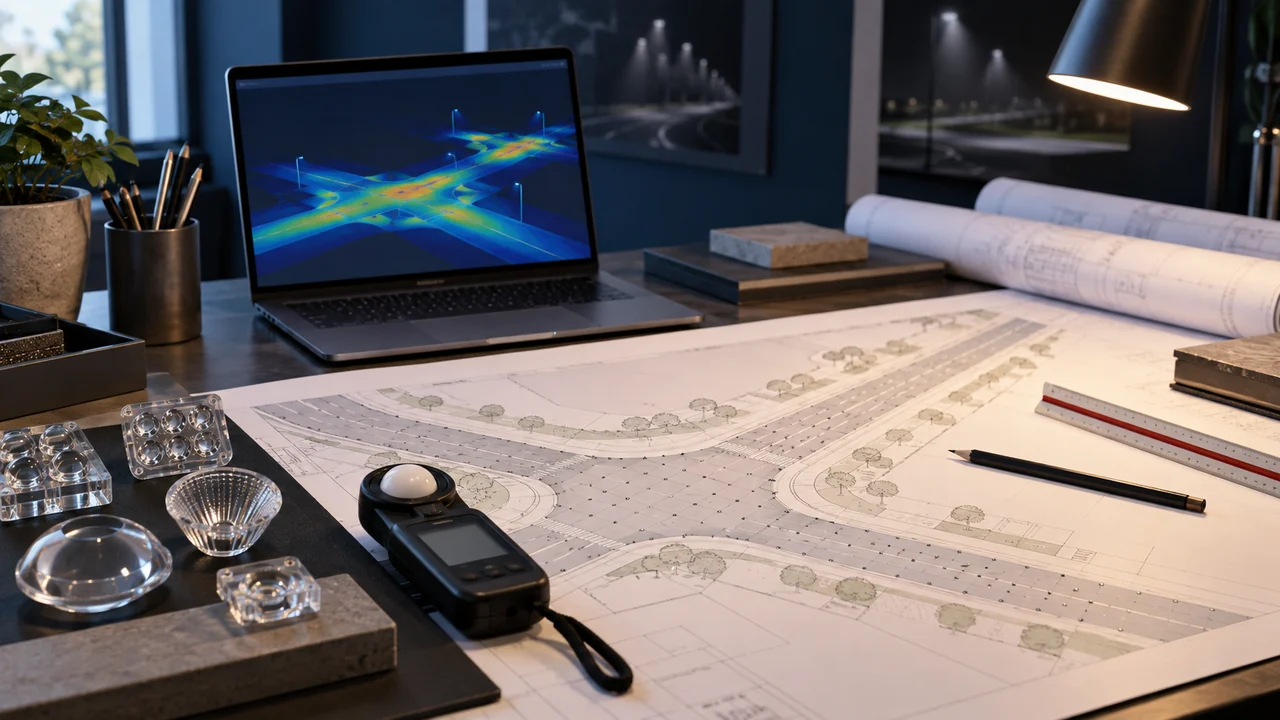
Studio illuminotecnico con planimetria, ottiche e simulazione della luce. Immagine illustrativa generata con AI.
Overview
Adaptive lighting adjusts output based on measured conditions rather than fixed schedules. Cycle and pedestrian routes need modest levels but high quality: face recognition, obstacle perception and route continuity. This contribution examines under which conditions adaptive control delivers real benefit in cycle path and pedestrian route lighting and which mistakes compromise it.
Applicable standards
The regulatory reference for cycle path and pedestrian route lighting is not a single document but a coordinated set of standards covering performance, safety and environmental impact. In design practice the following documents drive the main choices.
EN 13201-2 — P classes for pedestrian and cycle areas.
CIE 115 — criteria for vulnerable users.
regional laws — limits on spill light and operating hours.
Types of control
There are three main families: daylight-linked control, presence or passage control, and control based on activity level. Each needs different sensors, placements and calibration. Combining them without a priority logic produces unpredictable behaviour that users perceive as faults.
When it pays off
Adaptive control pays off where there is real, sustained variability: spaces with significant daylight contribution, areas with intermittent occupancy, routes with very different flows across the day. Where conditions are constant, a well-tuned fixed profile achieves the same result with fewer components and fewer failures. In cycle path and pedestrian route lighting the assessment must be based on real usage data for the area.
Calibration and placement mistakes
The most common problems are sensor placement in a non-representative area, hold times that are too short and cause switching perceived as annoying, and thresholds set once and never revised. Calibration must be carried out on site with the space in real operating conditions and repeated after the first period of use.
The minimum level required by applicable standards must also be guaranteed at the lowest dimming condition: the saving function cannot reduce performance below the safety requirement.
Recurring critical points
The difficulties that most often emerge in cycle path and pedestrian route lighting projects are not about product selection, but about defining requirements and verifying results.
Lighting without spilling into homes and adjacent natural habitats.
Ensuring face recognition at a safe distance.
Serving sections with no electrical grid.
Design approach
An orderly method drastically reduces variations during works and disputes at commissioning. Three choices make the difference from the earliest stages.
Controlled-distribution optics with shielding towards sensitive areas.
Neutral colour temperatures and colour rendering adequate for recognition.
Standalone solutions with storage and presence sensors where the grid is absent.
Parameters to verify
P class — EN 13201-2 — horizontal and semi-cylindrical illuminance
Semi-cylindrical illuminance — EN 13201-2 — face recognition
Spill light — regional laws — zero ULOR and shielding
Continuity — good practice — no perceived dark gaps
Most frequent mistakes
Non-conformities found at commissioning almost always come from three causes: requirements not declared or declared without a reference standard, calculation run on idealised geometry, and an optimistic maintenance factor. All three can be avoided at zero cost during design.
Key takeaways
A cycle path and pedestrian route lighting project holds up over time when requirements are declared, the calculation reproduces real conditions and on-site verification follows an agreed protocol. Component selection matters, but comes later: without measurable requirements even the best product delivers a result that cannot be demonstrated. Centro Studi Lumeitalia makes its technical office available to review requirements and design checks.
Methodological note: This content is written for technical information purposes by Centro Studi Lumeitalia and does not replace the lighting design or a full reading of the standards cited. Applicable performance values are those of the standards in force at design time.
Domande frequenti
Do these routes need the same light as a carriageway?+
No. P classes require lower levels, but demand attention to face recognition and uniformity along the route.
Is sensor-based lighting allowed?+
Yes, provided the base level ensures safety and the presence-triggered increase is designed to avoid sudden glare.
Where should a cycle path and pedestrian route lighting project start?+
From a written definition of performance requirements and verification conditions: this step drives every later choice and makes the result either disputable or defensible at commissioning.
Which documents should be requested from the supplier?+
Photometric files of the proposed luminaires, declaration of conformity, lifetime data declared per IES LM-80 with its conditions, the maintenance schedule and warranty terms.
Lumeitalia — Sistemi LED professionali
Lumeitalia è il brand di illuminazione LED professionale di Mya Tech S.r.l., azienda italiana fondata nel 2011 a Trezzano sul Naviglio (MI); il brand è attivo dal 2020.