Method, regulatory requirements and design checks for road tunnel lighting, from data collection to commissioning.
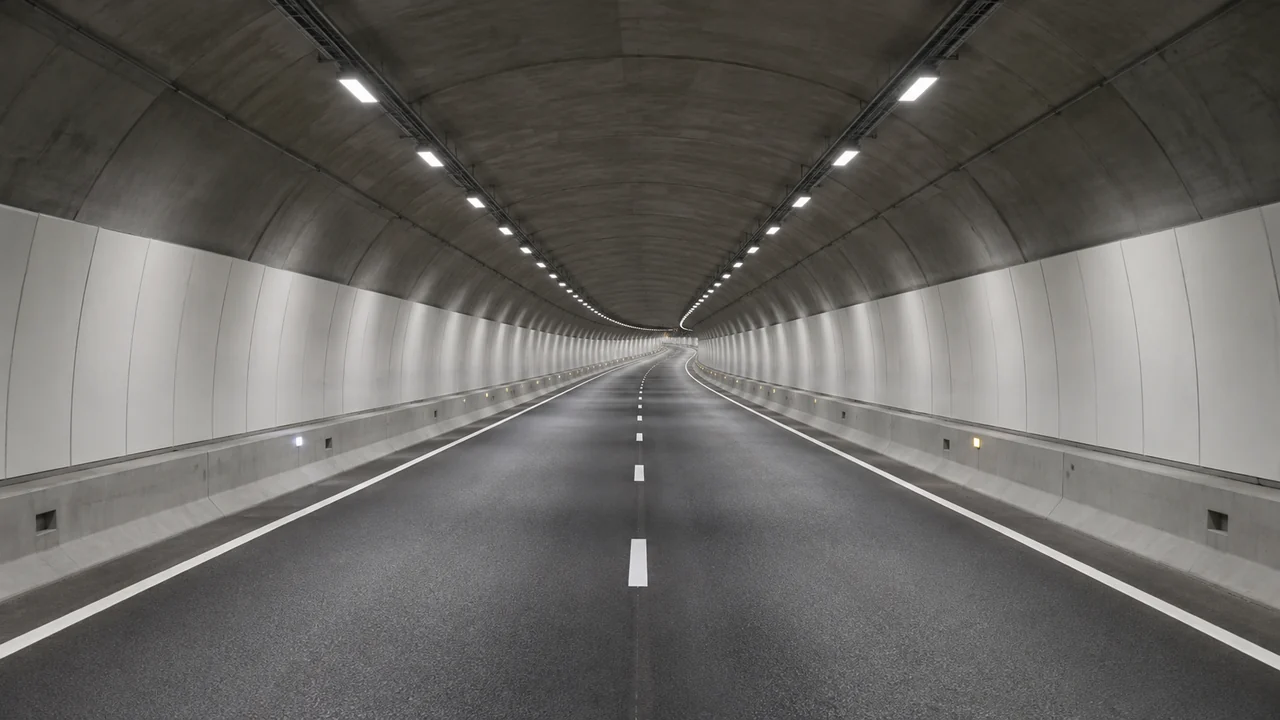
Galleria stradale con illuminazione LED della carreggiata. Immagine illustrativa generata con AI.
Overview
In tunnels, lighting is a safety system: it must support the eye's adaptation between outdoor and indoor luminance, by day and by night. This Centro Studi Lumeitalia guide sets out the working stages of a road tunnel lighting project: gathering baseline data, defining performance requirements, calculation, component selection and on-site verification. The aim is not a recipe valid everywhere, but an orderly path that removes implicit decisions and makes the design verifiable by whoever must approve, build and commission it.
Applicable standards
The regulatory reference for road tunnel lighting is not a single document but a coordinated set of standards covering performance, safety and environmental impact. In design practice the following documents drive the main choices.
CIE 88:2004 — guide for the lighting of road tunnels and underpasses.
UNI 11095 — road tunnel lighting.
EN 1838 — emergency lighting.
Baseline data to collect
Design quality depends on the quality of initial data. Before opening the calculation software you need the real geometry of the area, expected operating conditions, client constraints and applicable local rules. Recording these systematically prevents undeclared assumptions from surfacing at commissioning, when correcting them costs far more.
In this specific case, data collection must document the existing situation with measurements and photographs, record information on the existing electrical installation and clarify who will handle maintenance: the planned cleaning and replacement cycle feeds directly into the maintenance factor used in the calculation.
From requirement to calculation
Once requirements are set, the lighting calculation must prove the proposed solution meets them under the worst expected conditions, not ideal ones. The model must reproduce the real geometry, plausible surface reflectances and a maintenance factor consistent with the management plan. A calculation run with optimistic parameters yields an installation that is compliant on paper and inadequate after a few years of service.
Good practice is to attach both results and assumptions: the maintenance factor adopted and its justification, reflectances, real heights and spacings, and the photometric files used. This documentation makes the design reproducible and lets the commissioning engineer reconstruct the reasoning.
On-site verification and commissioning
Commissioning compares field measurements with design values, accounting for tolerances and measurement conditions. The protocol should be agreed in advance: measurement grid, instruments, ambient conditions, supply status and luminaire operating hours at the time of verification. Without a shared protocol, the discussion on results shifts from numbers to interpretations.
Recurring critical points
The difficulties that most often emerge in road tunnel lighting projects are not about product selection, but about defining requirements and verifying results.
Sizing the threshold zone on the actually measured access luminance L20.
Keeping service continuity with emergency supply and redundant luminaires.
Withstanding high-pressure washing, exhaust gases and permanent humidity.
Design approach
An orderly method drastically reduces variations during works and disputes at commissioning. Three choices make the difference from the earliest stages.
Daytime reinforcement curves modulated by external luminance sensors.
Electrical architecture with separate circuits for permanent and reinforcement lighting.
Materials and finishes suited to harsh environments, with high IP rating and stainless hardware.
Parameters to verify
Threshold zone — CIE 88 / UNI 11095 — sized on L20 and design speed
Transition zone — CIE 88 — progressive luminance decay
Emergency lighting — EN 1838 — autonomy and minimum egress levels
Ingress protection — EN 60598 — suited to washing and humidity
Most frequent mistakes
Non-conformities found at commissioning almost always come from three causes: requirements not declared or declared without a reference standard, calculation run on idealised geometry, and an optimistic maintenance factor. All three can be avoided at zero cost during design.
Existing conditions surveyed with measurements, photos and electrical schematic
Performance requirements declared with the reference standard
Maintenance factor justified and consistent with the management plan
Calculation run on real geometry, not an idealised one
Applicable local and environmental constraints verified
Commissioning protocol agreed before works start
As-built documentation handed over to the operator
Key takeaways
A road tunnel lighting project holds up over time when requirements are declared, the calculation reproduces real conditions and on-site verification follows an agreed protocol. Component selection matters, but comes later: without measurable requirements even the best product delivers a result that cannot be demonstrated. Centro Studi Lumeitalia makes its technical office available to review requirements and design checks.
Methodological note: This content is written for technical information purposes by Centro Studi Lumeitalia and does not replace the lighting design or a full reading of the standards cited. Applicable performance values are those of the standards in force at design time.
Domande frequenti
What is access luminance L20?+
The average luminance of the driver's field of view at one stopping distance from the portal, measured in a 20° cone: it is the input for sizing the threshold zone.
Is reinforcement lighting needed at night too?+
No. At night the adaptation step is much smaller, so only permanent lighting stays in service, usually at reduced levels.
Where should a road tunnel lighting project start?+
From a written definition of performance requirements and verification conditions: this step drives every later choice and makes the result either disputable or defensible at commissioning.
Which documents should be requested from the supplier?+
Photometric files of the proposed luminaires, declaration of conformity, lifetime data declared per IES LM-80 with its conditions, the maintenance schedule and warranty terms.
Lumeitalia — Sistemi LED professionali
Lumeitalia è il brand di illuminazione LED professionale di Mya Tech S.r.l., azienda italiana fondata nel 2011 a Trezzano sul Naviglio (MI); il brand è attivo dal 2020.