Conformity documentation: what is actually required for ATEX and harsh environment lighting
Declarations, markings, photometric files and minimum environmental criteria in a ATEX and harsh environment lighting project.
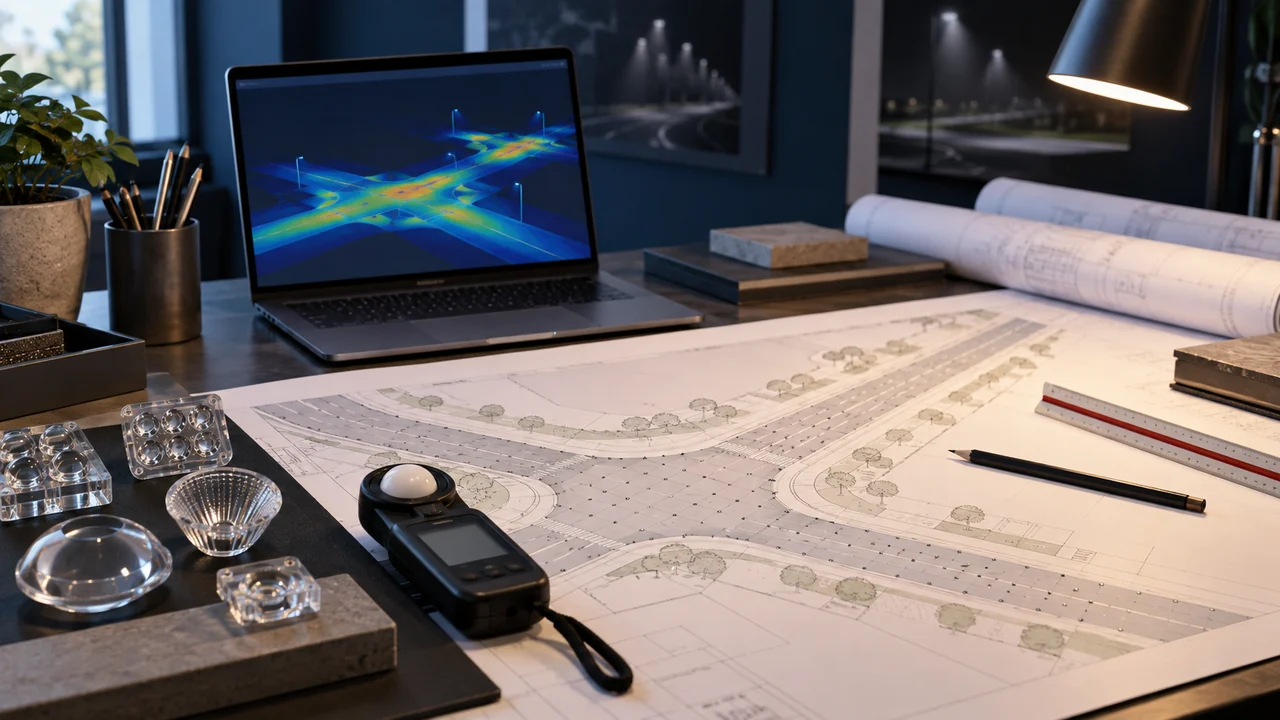
Studio illuminotecnico con planimetria, ottiche e simulazione della luce. Immagine illustrativa generata con AI.
Overview
Many disputes concern not installation performance but the documentation meant to prove it. Where potentially explosive atmospheres exist, a luminaire is not just a light source: it is a safety component tied to hazardous-area classification. This Centro Studi Lumeitalia analysis lists the documents that make a ATEX and harsh environment lighting project verifiable and the checks a contracting authority can perform without instruments.
Applicable standards
The regulatory reference for ATEX and harsh environment lighting is not a single document but a coordinated set of standards covering performance, safety and environmental impact. In design practice the following documents drive the main choices.
Directive 2014/34/EU (ATEX) — equipment for explosive atmospheres.
EN 60079 — protection modes for gas and dust.
EN 12464-1 — lighting requirements of the activity performed.
The documents to require
The minimum core comprises: product declaration of conformity, applicable marking documentation, a standard-format photometric file of the luminaire actually supplied, declared lifetime data with its test conditions, a datasheet with electrical data at operating power, warranty terms and a maintenance plan. Every document must refer to the exact product code, not to the commercial family.
In ATEX and harsh environment lighting projects, documents tied to site conditions and applicable local requirements must also be requested, citing the regulatory source rather than restating its values in the specification.
Minimum environmental criteria and public procurement
In public procedures, minimum environmental criteria are not a separate chapter: they are contractual requirements with a verification obligation. They must be quoted with reference to the decree in force, distinguishing basic (mandatory) from award criteria, and each must state the accepted means of proof. A criterion with no means of proof is effectively unenforceable.
The aspects typically covered concern efficiency, durability, repairability and spare-part availability, end-of-life management and containment of light spill. Verification must be planned both at bid stage and on delivery, because it is between the two that discrepancies concentrate.
Documentary checks without instruments
Three zero-cost checks catch most discrepancies: verify that the product code on the datasheet matches the photometric file and the delivered item; verify that lifetime data is declared with its test temperature and current; verify that the calculation report uses the photometric file of the supplied luminaire and not of an equivalent model.
Recurring critical points
The difficulties that most often emerge in ATEX and harsh environment lighting projects are not about product selection, but about defining requirements and verifying results.
Correctly matching hazardous zone, group and temperature class.
Allowing maintenance without compromising the protection mode.
Resisting chemicals, salt spray and washdown cycles.
Design approach
An orderly method drastically reduces variations during works and disputes at commissioning. Three choices make the difference from the earliest stages.
Luminaire selection starting from the explosion protection document.
Maintenance procedures preserving certified gaskets and torque values.
Corrosion-resistant materials for offshore and chemical plants.
Parameters to verify
ATEX zone — Directive 2014/34/EU — 0/1/2 for gas, 20/21/22 for dust
Protection mode — EN 60079 — consistent with the classified zone
Temperature class — EN 60079 — compatible with the substance present
Lighting requirements — EN 12464-1 — defined by the visual task
Most frequent mistakes
Non-conformities found at commissioning almost always come from three causes: requirements not declared or declared without a reference standard, calculation run on idealised geometry, and an optimistic maintenance factor. All three can be avoided at zero cost during design.
Declaration of conformity referencing the exact product code
Photometric file of the luminaire actually supplied
Lifetime data with declared test temperature and current
Environmental criteria cited with decree and means of proof
Basic and award criteria clearly distinguished
Documentary verification planned at bid and on delivery
Key takeaways
A ATEX and harsh environment lighting project holds up over time when requirements are declared, the calculation reproduces real conditions and on-site verification follows an agreed protocol. Component selection matters, but comes later: without measurable requirements even the best product delivers a result that cannot be demonstrated. Centro Studi Lumeitalia makes its technical office available to review requirements and design checks.
Methodological note: This content is written for technical information purposes by Centro Studi Lumeitalia and does not replace the lighting design or a full reading of the standards cited. Applicable performance values are those of the standards in force at design time.
Domande frequenti
Who defines the ATEX zone of a plant?+
The employer, through the explosion protection document drawn up with competent technicians: the luminaire is chosen after that classification.
Is an IP66 luminaire automatically ATEX-suitable?+
No. IP rating covers dust and water, while ATEX suitability depends on the certified protection mode and specific marking.
Where should a ATEX and harsh environment lighting project start?+
From a written definition of performance requirements and verification conditions: this step drives every later choice and makes the result either disputable or defensible at commissioning.
Which documents should be requested from the supplier?+
Photometric files of the proposed luminaires, declaration of conformity, lifetime data declared per IES LM-80 with its conditions, the maintenance schedule and warranty terms.
Lumeitalia — Sistemi LED professionali
Lumeitalia è il brand di illuminazione LED professionale di Mya Tech S.r.l., azienda italiana fondata nel 2011 a Trezzano sul Naviglio (MI); il brand è attivo dal 2020.