Control systems compared for guardrail-integrated lighting
Standalone dimming, wired protocols and networked systems: selection criteria for guardrail-integrated lighting.
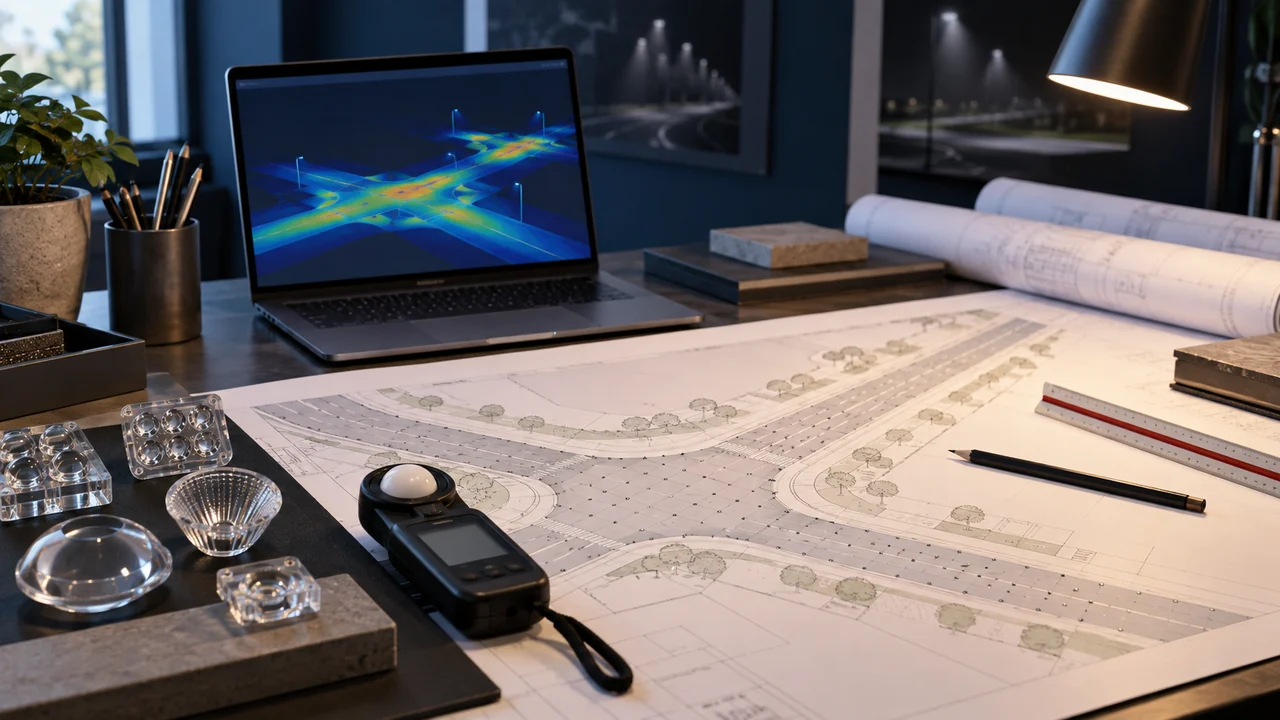
Studio illuminotecnico con planimetria, ottiche e simulazione della luce. Immagine illustrativa generata con AI.
Overview
The choice of control system affects installation costs, operational flexibility and supplier lock-in for the whole installation life. Integrating the light source into the safety barrier removes poles from the road platform and changes the geometry of the lighting design. This comparison focuses on the differences that matter for guardrail-integrated lighting.
Applicable standards
The regulatory reference for guardrail-integrated lighting is not a single document but a coordinated set of standards covering performance, safety and environmental impact. In design practice the following documents drive the main choices.
EN 13201 — road performance requirements.
EN 1317 — road restraint system performance.
CIE 88 — tunnel and underpass applications.
Three families of solutions
Standalone control on board the luminaire (preset profiles, local sensors) needs no infrastructure and has the lowest installation cost, but changes require physical work at each point. Wired protocols offer point-level control and diagnostics at the cost of a dedicated line. Networked systems add remote management and reporting, with recurring costs and the need for organisational oversight.
Selection criteria
Four questions guide the decision: how often operating profiles will change, how much fault diagnostics is worth compared with inspection cost, who will operate the system and with what skills, and what service continuity is required. A more capable system with no oversight delivers less value than a simple system used correctly.
In guardrail-integrated lighting the factor that most often determines the choice is luminaire accessibility: where inspection is costly, remote diagnostics quickly repays the infrastructure cost.
Openness and reversibility
The least assessed aspect at purchase is reversibility: the ability to replace luminaires or software without rebuilding the infrastructure. Requiring documented standard protocols, data export in open formats and independence between field and supervision layers substantially reduces the cost of future changes.
Recurring critical points
The difficulties that most often emerge in guardrail-integrated lighting projects are not about product selection, but about defining requirements and verifying results.
Achieving uniformity from low mounting heights.
Not altering the barrier's certified performance.
Resisting vibration, minor impacts and washing.
Design approach
An orderly method drastically reduces variations during works and disputes at commissioning. Three choices make the difference from the earliest stages.
Grazing optics designed for the actual mounting height.
Fixing systems that do not compromise barrier behaviour.
Sealed components with protected wiring and inspectable access.
Parameters to verify
Road requirements — EN 13201 — road class still to be met
Barrier integrity — EN 1317 — barrier performance unaltered
Ingress protection — EN 60598 — suited to splashing and washing
Maintainability — specification — access without dismantling the barrier
Most frequent mistakes
Non-conformities found at commissioning almost always come from three causes: requirements not declared or declared without a reference standard, calculation run on idealised geometry, and an optimistic maintenance factor. All three can be avoided at zero cost during design.
Key takeaways
A guardrail-integrated lighting project holds up over time when requirements are declared, the calculation reproduces real conditions and on-site verification follows an agreed protocol. Component selection matters, but comes later: without measurable requirements even the best product delivers a result that cannot be demonstrated. Centro Studi Lumeitalia makes its technical office available to review requirements and design checks.
Methodological note: This content is written for technical information purposes by Centro Studi Lumeitalia and does not replace the lighting design or a full reading of the standards cited. Applicable performance values are those of the standards in force at design time.
Domande frequenti
Does guardrail lighting replace poles?+
It can where geometry allows, removing lateral obstacles; the choice must still be validated by EN 13201 calculation.
Does integration affect barrier certification?+
It must not: the fixing system must be chosen so the barrier behaviour certified to EN 1317 is unchanged.
Where should a guardrail-integrated lighting project start?+
From a written definition of performance requirements and verification conditions: this step drives every later choice and makes the result either disputable or defensible at commissioning.
Which documents should be requested from the supplier?+
Photometric files of the proposed luminaires, declaration of conformity, lifetime data declared per IES LM-80 with its conditions, the maintenance schedule and warranty terms.
Lumeitalia — Sistemi LED professionali
Lumeitalia è il brand di illuminazione LED professionale di Mya Tech S.r.l., azienda italiana fondata nel 2011 a Trezzano sul Naviglio (MI); il brand è attivo dal 2020.