How to compare two technical bids for urban street lighting
A method for reading urban street lighting bids side by side: what is comparable, what is not and where the differences hide.
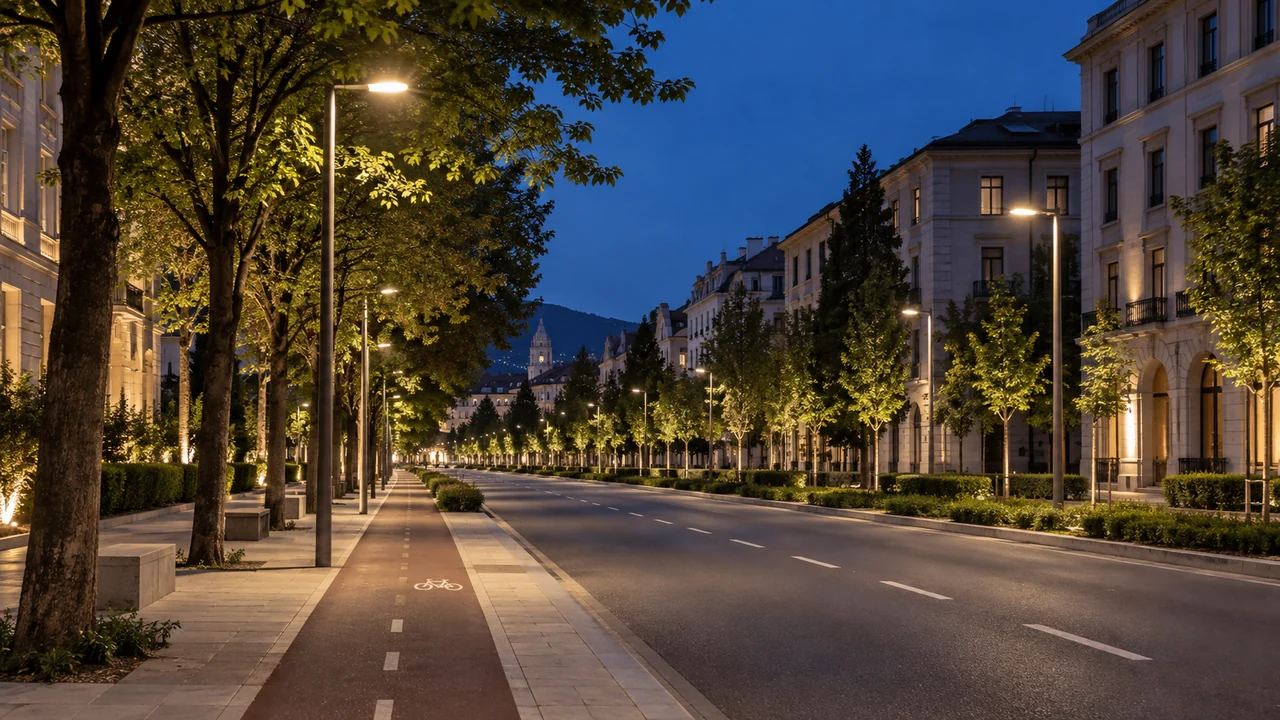
Viale urbano e percorso ciclabile illuminati da apparecchi LED. Immagine illustrativa generata con AI.
Overview
Two bids with the same luminaire count and installed power can describe profoundly different installations. The urban road network is the largest lit infrastructure managed by Italian municipalities and accounts for the biggest share of municipal energy spending. This methodological comparison by Centro Studi Lumeitalia explains how to read two urban street lighting proposals in parallel without stopping at price.
Applicable standards
The regulatory reference for urban street lighting is not a single document but a coordinated set of standards covering performance, safety and environmental impact. In design practice the following documents drive the main choices.
EN 13201-2 — performance requirements for M, C and P classes.
EN 13201-3 — calculation of performance.
UNI 11248 — road classification and selection of lighting classes.
Bringing bids onto a common basis
The first step is checking that both proposals assume the same requirements, the same geometry and the same maintenance factor. If one calculates for a new installation and the other at end of life, comparison is impossible until the assumptions are realigned. The same check applies to annual operating hours and the planned dimming profile.
In urban street lighting projects, differences frequently arise from a different reading of site conditions: clarifying this point in writing is worth more than any comparison table.
Where the differences hide
Photometry — File of the proposed luminaire, not an equivalent — Calculation not reproducible
Maintenance factor — Value and associated cleaning cycle — Below-target performance at end of life
Control — Protocol, dimming curve, signal-loss behaviour — Declared savings not achieved
Maintenance — Cycles, access, spares and lead times — Operating cost above budget
Warranty — Duration, exclusions, validity conditions — Unplanned burden on the client
From price to cost of ownership
A meaningful economic comparison spans the whole operating period: initial investment, annual consumption under the planned dimming conditions, cost of planned maintenance and an estimate of replacements. Energy price and inflation assumptions must be declared: changing them changes the outcome, and undeclared they make the comparison non-reproducible.
The selection criterion must be written before bids are received. Setting parameter weights afterwards is the practice that generates the most disputes in comparative procedures.
Recurring critical points
The difficulties that most often emerge in urban street lighting projects are not about product selection, but about defining requirements and verifying results.
Classifying the road correctly, avoiding oversizing that turns into wasted energy.
Achieving uniformity and glare control on pole spacings inherited from legacy installations.
Meeting regional light-pollution limits without reducing perceived safety.
Design approach
An orderly method drastically reduces variations during works and disputes at commissioning. Three choices make the difference from the earliest stages.
Risk analysis per UNI 11248 with adaptive lighting classes.
Optics designed for the real carriageway geometry instead of generic distributions.
Flux regulation by time band and traffic, with profiles set during commissioning.
Parameters to verify
Lighting class — UNI 11248 / EN 13201-2 — set by risk analysis, not by road width
Overall uniformity U0 — EN 13201-2 — minimum requirement per class
Threshold increment TI — EN 13201-2 — to be verified in the calculation
ULOR — regional laws — upward flux to be brought to zero
Most frequent mistakes
Non-conformities found at commissioning almost always come from three causes: requirements not declared or declared without a reference standard, calculation run on idealised geometry, and an optimistic maintenance factor. All three can be avoided at zero cost during design.
Same assumptions on requirements, geometry and operating hours
Maintenance factor aligned across proposals
Photometric files of the luminaires actually offered
Maintenance and spare-part items quantified
Economic assumptions (energy, inflation) declared
Selection criterion defined before bids are opened
Key takeaways
A urban street lighting project holds up over time when requirements are declared, the calculation reproduces real conditions and on-site verification follows an agreed protocol. Component selection matters, but comes later: without measurable requirements even the best product delivers a result that cannot be demonstrated. Centro Studi Lumeitalia makes its technical office available to review requirements and design checks.
Methodological note: This content is written for technical information purposes by Centro Studi Lumeitalia and does not replace the lighting design or a full reading of the standards cited. Applicable performance values are those of the standards in force at design time.
Domande frequenti
Who decides the lighting class of a road?+
The designer, through the risk analysis required by UNI 11248, based on traffic, vulnerable users, visual complexity and accident rate.
Can light levels be reduced at night?+
Yes. UNI 11248 allows adaptive regulation when risk parameters change, provided the profile is documented in the design and verifiable at commissioning.
Where should a urban street lighting project start?+
From a written definition of performance requirements and verification conditions: this step drives every later choice and makes the result either disputable or defensible at commissioning.
Which documents should be requested from the supplier?+
Photometric files of the proposed luminaires, declaration of conformity, lifetime data declared per IES LM-80 with its conditions, the maintenance schedule and warranty terms.
Lumeitalia — Sistemi LED professionali
Lumeitalia è il brand di illuminazione LED professionale di Mya Tech S.r.l., azienda italiana fondata nel 2011 a Trezzano sul Naviglio (MI); il brand è attivo dal 2020.