Luminaire body materials compared in cycle path and pedestrian route lighting
Aluminium, polymer-matrix composite filled with graphite and technopolymers: weight, heat dissipation, durability and impact in cycle path and pedestrian route lighting projects.
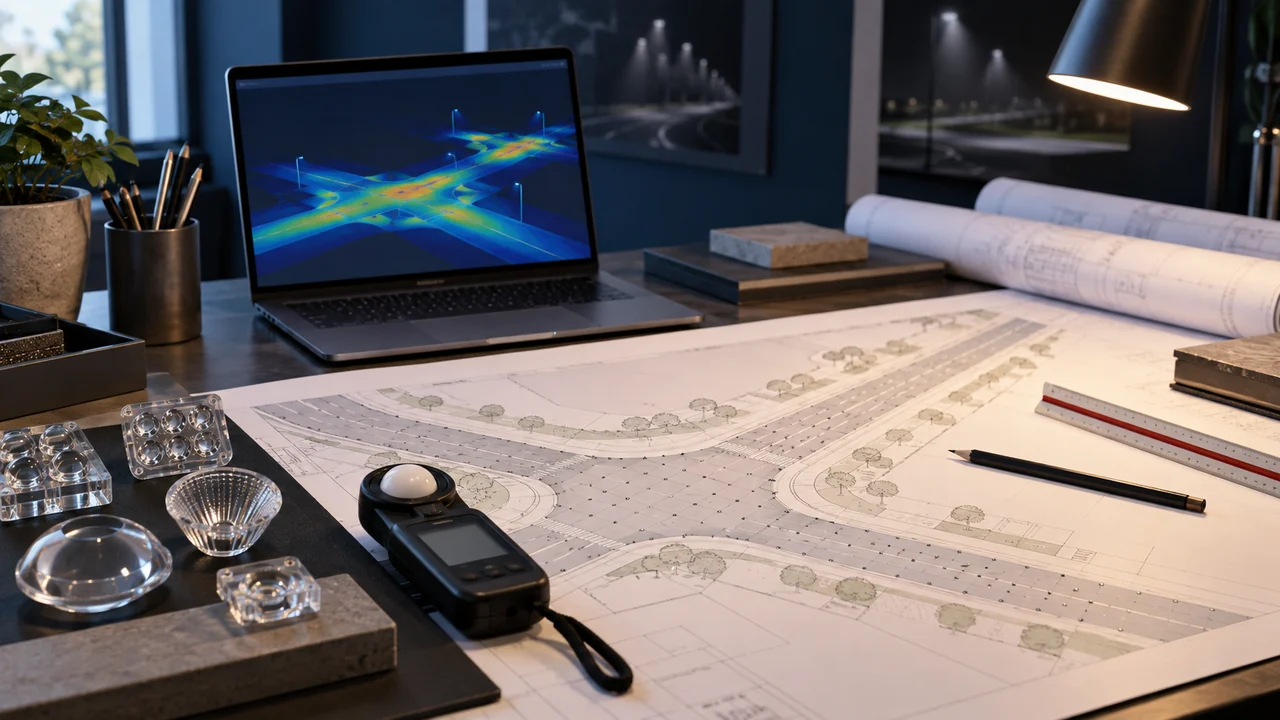
Studio illuminotecnico con planimetria, ottiche e simulazione della luce. Immagine illustrativa generata con AI.
Overview
The luminaire body material drives heat dissipation, load on structures, corrosion resistance and the environmental footprint of the supply. Cycle and pedestrian routes need modest levels but high quality: face recognition, obstacle perception and route continuity. This comparison examines the available alternatives for cycle path and pedestrian route lighting with design rather than commercial criteria.
Applicable standards
The regulatory reference for cycle path and pedestrian route lighting is not a single document but a coordinated set of standards covering performance, safety and environmental impact. In design practice the following documents drive the main choices.
EN 13201-2 — P classes for pedestrian and cycle areas.
CIE 115 — criteria for vulnerable users.
regional laws — limits on spill light and operating hours.
The alternatives on the table
Die-cast aluminium remains the most widespread solution: good conductivity, mature process, predictable cost, but high mass and significant production footprint. Technopolymers reduce weight and corrosion, with lower conductivity that must be compensated in the thermal design. Graphite thermally conductive composite offers high conductivity with contained mass, reducing the load on supporting structures and the impact of the production stage.
Design evaluation criteria
The comparison must be made at equal required performance, considering four items: component operating temperature, total weight on the support, behaviour in the specific site environment and maintenance constraints. In cycle path and pedestrian route lighting weight matters when existing structures were not sized for current luminaires, a recurring situation in works on historic installations.
Environmental impact and end of life
A correct environmental assessment covers the whole cycle: raw materials, production, transport, operation and end of life. A material with a lower production footprint but shorter service life is not necessarily better; likewise, mass reduction affects transport and site handling. The ability to separate materials at end of life is a criterion that is becoming standard in public procurement.
Lumeitalia adopts graphite thermally conductive composite with the Cool-X® system to combine conductivity and reduced mass, keeping production in Italy and component traceability.
Recurring critical points
The difficulties that most often emerge in cycle path and pedestrian route lighting projects are not about product selection, but about defining requirements and verifying results.
Lighting without spilling into homes and adjacent natural habitats.
Ensuring face recognition at a safe distance.
Serving sections with no electrical grid.
Design approach
An orderly method drastically reduces variations during works and disputes at commissioning. Three choices make the difference from the earliest stages.
Controlled-distribution optics with shielding towards sensitive areas.
Neutral colour temperatures and colour rendering adequate for recognition.
Standalone solutions with storage and presence sensors where the grid is absent.
Parameters to verify
P class — EN 13201-2 — horizontal and semi-cylindrical illuminance
Semi-cylindrical illuminance — EN 13201-2 — face recognition
Spill light — regional laws — zero ULOR and shielding
Continuity — good practice — no perceived dark gaps
Most frequent mistakes
Non-conformities found at commissioning almost always come from three causes: requirements not declared or declared without a reference standard, calculation run on idealised geometry, and an optimistic maintenance factor. All three can be avoided at zero cost during design.
Key takeaways
A cycle path and pedestrian route lighting project holds up over time when requirements are declared, the calculation reproduces real conditions and on-site verification follows an agreed protocol. Component selection matters, but comes later: without measurable requirements even the best product delivers a result that cannot be demonstrated. Centro Studi Lumeitalia makes its technical office available to review requirements and design checks.
Methodological note: This content is written for technical information purposes by Centro Studi Lumeitalia and does not replace the lighting design or a full reading of the standards cited. Applicable performance values are those of the standards in force at design time.
Domande frequenti
Do these routes need the same light as a carriageway?+
No. P classes require lower levels, but demand attention to face recognition and uniformity along the route.
Is sensor-based lighting allowed?+
Yes, provided the base level ensures safety and the presence-triggered increase is designed to avoid sudden glare.
Where should a cycle path and pedestrian route lighting project start?+
From a written definition of performance requirements and verification conditions: this step drives every later choice and makes the result either disputable or defensible at commissioning.
Which documents should be requested from the supplier?+
Photometric files of the proposed luminaires, declaration of conformity, lifetime data declared per IES LM-80 with its conditions, the maintenance schedule and warranty terms.
Lumeitalia — Sistemi LED professionali
Lumeitalia è il brand di illuminazione LED professionale di Mya Tech S.r.l., azienda italiana fondata nel 2011 a Trezzano sul Naviglio (MI); il brand è attivo dal 2020.