How to compare luminaires for retail and showroom lighting without mistakes
A comparison method for luminaires intended for retail and showroom lighting: what to look at, what to ignore, how to make data comparable.
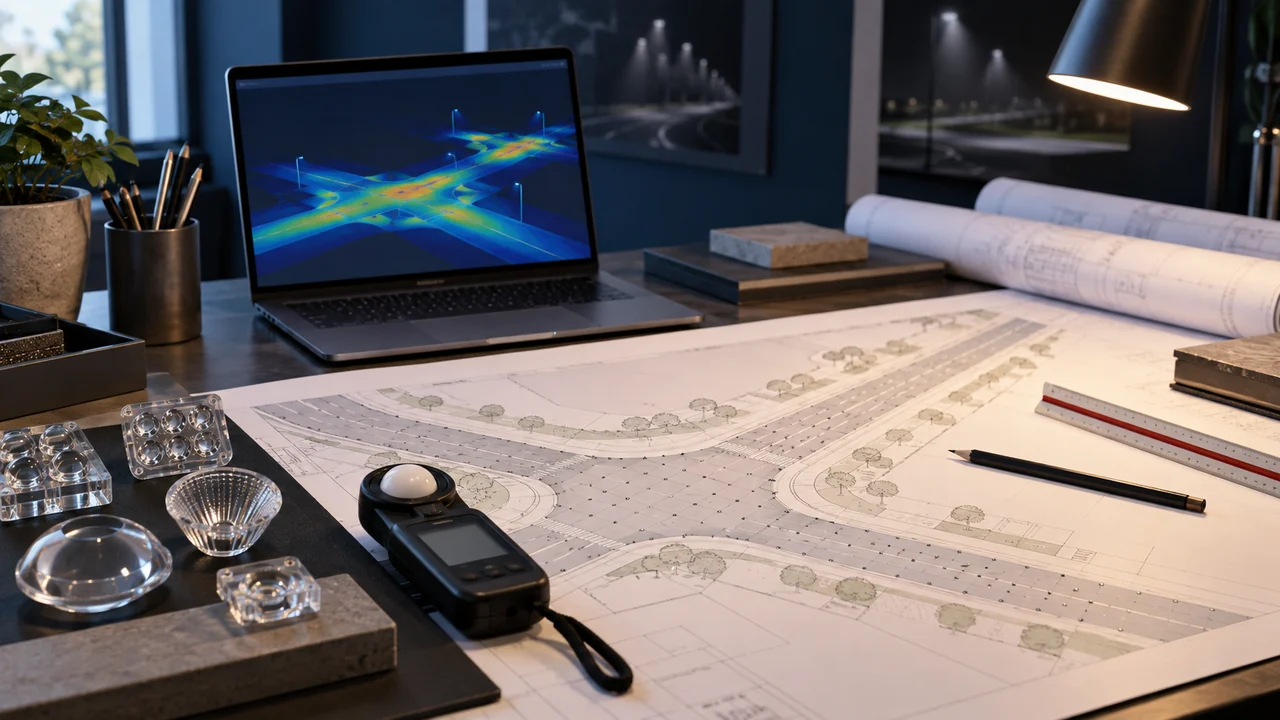
Studio illuminotecnico con planimetria, ottiche e simulazione della luce. Immagine illustrativa generata con AI.
Overview
Comparing two datasheets is not the same as comparing two installations. In retail and showroom lighting projects the right choice only emerges by simulating both solutions in the real geometry and assessing their behaviour over time. In retail, light is a communication tool: it must make products recognisable and desirable while keeping running costs sustainable.
Applicable standards
The regulatory reference for retail and showroom lighting is not a single document but a coordinated set of standards covering performance, safety and environmental impact. In design practice the following documents drive the main choices.
EN 12464-1 — requirements for sales and storage areas.
energy criteria — efficiency in refurbishment projects.
EN 1838 — safety lighting for the public.
Making data comparable
The first step is checking that data come from homogeneous test conditions and that photometric files refer to the configuration actually offered, not to a different variant of the same family. Comparing data gathered under different conditions produces arbitrary conclusions, however precise the numbers look.
Simulate, do not extrapolate
Meaningful comparison happens in the project geometry: same grid, same heights, same maintenance factor, same reflectances. Only then can you see which solution meets requirements with lower installed power or fewer light points. Extrapolating from headline figures often leads to conclusions opposite to those of the simulation.
The lighting result should then be paired with an assessment of maintainability, spare-part availability and compatibility with the planned control systems: factors absent from the calculation but decisive over the whole life cycle.
Comparisons that mislead
Comparing luminaires with different distributions using wattage alone.
Using photometric files from a variant other than the one offered.
Ignoring the maintenance factor, which depends on environment and cleaning cycle.
Assessing purchase price without considering spares and maintenance access.
Recurring critical points
The difficulties that most often emerge in retail and showroom lighting projects are not about product selection, but about defining requirements and verifying results.
Achieving effective accents without excessive contrast and fatigue.
Ensuring colour fidelity on textiles, food and materials.
Keeping consistency across stores of the same chain.
Design approach
An orderly method drastically reduces variations during works and disputes at commissioning. Three choices make the difference from the earliest stages.
Accent ratios designed per product category.
Colour rendering and tone selected for the displayed materials.
A chain specification fixing repeatable parameters in every store.
Parameters to verify
General illuminance — EN 12464-1 — sales area baseline
Accent ratio — good practice — between product and background
Colour rendering — specification — suited to the product category
Safety — EN 1838 — public escape routes
Most frequent mistakes
Non-conformities found at commissioning almost always come from three causes: requirements not declared or declared without a reference standard, calculation run on idealised geometry, and an optimistic maintenance factor. All three can be avoided at zero cost during design.
Key takeaways
A retail and showroom lighting project holds up over time when requirements are declared, the calculation reproduces real conditions and on-site verification follows an agreed protocol. Component selection matters, but comes later: without measurable requirements even the best product delivers a result that cannot be demonstrated. Centro Studi Lumeitalia makes its technical office available to review requirements and design checks.
Methodological note: This content is written for technical information purposes by Centro Studi Lumeitalia and does not replace the lighting design or a full reading of the standards cited. Applicable performance values are those of the standards in force at design time.
Domande frequenti
How strong should product accent be?+
It depends on the format: too strong creates tiring contrast, too weak removes visual hierarchy. The ratio is set at concept stage and verified on site.
Does light affect product perception?+
Yes: colour rendering, tone and directionality change how materials and colours are perceived, which is why retail specifications fix them.
Where should a retail and showroom lighting project start?+
From a written definition of performance requirements and verification conditions: this step drives every later choice and makes the result either disputable or defensible at commissioning.
Which documents should be requested from the supplier?+
Photometric files of the proposed luminaires, declaration of conformity, lifetime data declared per IES LM-80 with its conditions, the maintenance schedule and warranty terms.
Lumeitalia — Sistemi LED professionali
Lumeitalia è il brand di illuminazione LED professionale di Mya Tech S.r.l., azienda italiana fondata nel 2011 a Trezzano sul Naviglio (MI); il brand è attivo dal 2020.