Life cycle and total cost of ownership in warehouse and logistics hub lighting installations
A long-term evaluation model for warehouse and logistics hub lighting investments: cost items, assumptions and sensitivity.
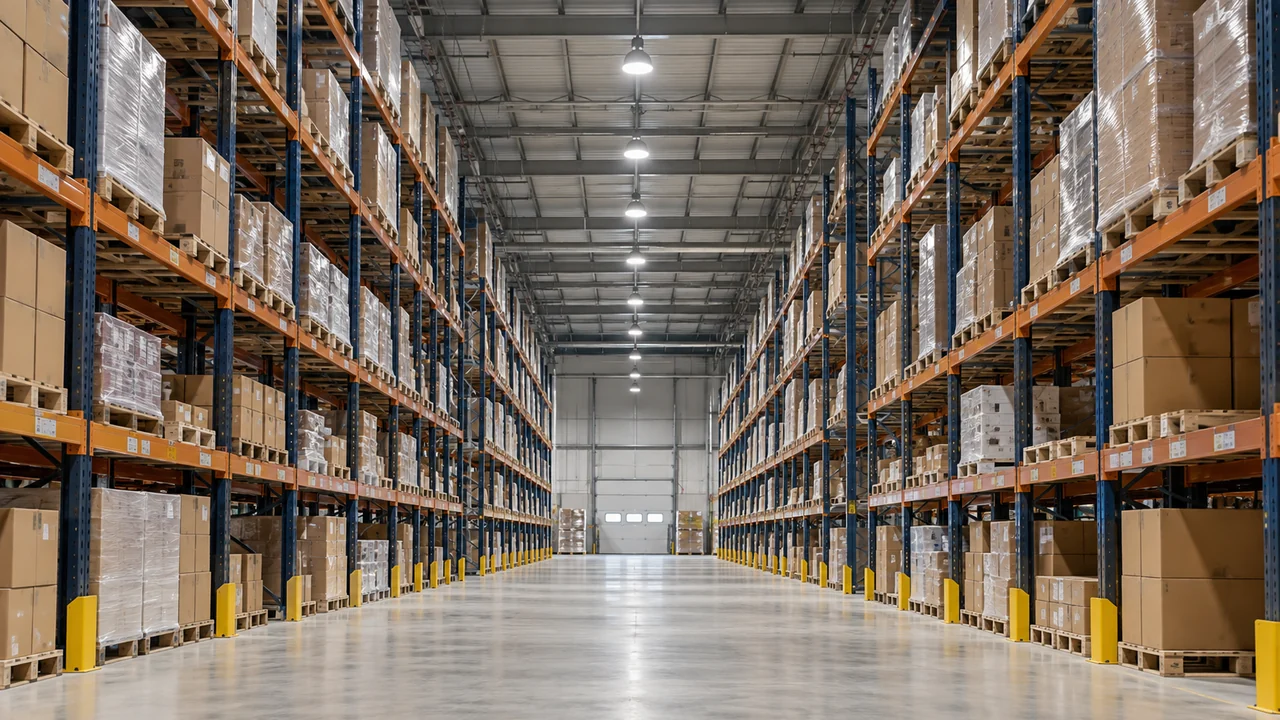
Corsie di un magazzino con scaffalature alte e illuminazione LED. Immagine illustrativa generata con AI.
Overview
The cost of a lighting installation is spread over a long horizon, where the initial investment often weighs less than energy and maintenance combined. In logistics hubs lighting runs almost continuously and must follow narrow aisles, high racking and moving vehicles. This Centro Studi Lumeitalia white paper proposes an evaluation model applicable to warehouse and logistics hub lighting interventions.
Applicable standards
The regulatory reference for warehouse and logistics hub lighting is not a single document but a coordinated set of standards covering performance, safety and environmental impact. In design practice the following documents drive the main choices.
EN 12464-1 — requirements for storage and picking areas.
Italian Legislative Decree 81/2008 — safety in materials handling.
EN 1838 — emergency lighting.
Model boundary
The model considers five items: initial investment (supply, installation, ancillary works), energy consumption over the period, planned maintenance, corrective maintenance and replacements, end-of-life management. Excluding an item is legitimate only if declared: a comparison ignoring maintenance systematically favours the least accessible solutions.
Investment — Supply, installation, ancillary works — Bid and bill of quantities
Energy — Operating power × hours × dimming profile — Datasheet and control design
Planned maintenance — Cycles, access equipment, times — Maintenance plan
Corrective and replacements — Expected failure rate and spares — Lifetime data and warranty
End of life — Disposal and material recovery — Applicable environmental requirements
Assumptions and sensitivity
Three assumptions dominate the outcome: energy price, operating hours and failure rate. The model should always be presented with a sensitivity analysis on these variables, showing how the result shifts under conservative and optimistic scenarios. A single figure with no range communicates a precision the model does not have.
For warehouse and logistics hub lighting, the cost component tied to luminaire accessibility must also be considered: two solutions with the same failure rate can have very different intervention costs.
Using the model in a decision
The model exists to make assumptions explicit, not to produce a definitive number. In a comparison, the spreadsheet with visible assumptions should be shared so each party can substitute its own values and test the robustness of the conclusion. That transparency is what makes the decision defensible before an audit body.
Recurring critical points
The difficulties that most often emerge in warehouse and logistics hub lighting projects are not about product selection, but about defining requirements and verifying results.
Lighting the rack face, not only the aisle floor.
Avoiding glare for forklift operators.
Matching levels between automated and manned areas.
Design approach
An orderly method drastically reduces variations during works and disputes at commissioning. Three choices make the difference from the earliest stages.
Narrow-distribution optics aligned with the aisle axis.
Per-aisle control with dedicated sensors and standby levels.
Different requirements for picking, storage and loading docks.
Parameters to verify
Vertical illuminance — EN 12464-1 — label legibility on the rack face
Aisle uniformity — EN 12464-1 — continuity along the axis
UGR — EN 12464-1 — workstations and driving cabs
Emergency — EN 1838 — aisles and exits
Most frequent mistakes
Non-conformities found at commissioning almost always come from three causes: requirements not declared or declared without a reference standard, calculation run on idealised geometry, and an optimistic maintenance factor. All three can be avoided at zero cost during design.
Five cost items included, or exclusions declared
Real operating power used instead of nominal rating
Maintenance cycles and access equipment quantified
Sensitivity analysis on energy, hours and failure rate
Assumptions shared in an editable format
Time horizon consistent with declared service life
Key takeaways
A warehouse and logistics hub lighting project holds up over time when requirements are declared, the calculation reproduces real conditions and on-site verification follows an agreed protocol. Component selection matters, but comes later: without measurable requirements even the best product delivers a result that cannot be demonstrated. Centro Studi Lumeitalia makes its technical office available to review requirements and design checks.
Methodological note: This content is written for technical information purposes by Centro Studi Lumeitalia and does not replace the lighting design or a full reading of the standards cited. Applicable performance values are those of the standards in force at design time.
Domande frequenti
Why does vertical illuminance matter in a warehouse?+
Because operators read codes and labels on the rack face, a vertical surface: an installation optimised only for the floor does not solve the visual task.
Are per-aisle sensors reliable with forklifts?+
Yes, if hold times and overlap zones are designed for vehicle speed, avoiding late switch-on.
Where should a warehouse and logistics hub lighting project start?+
From a written definition of performance requirements and verification conditions: this step drives every later choice and makes the result either disputable or defensible at commissioning.
Which documents should be requested from the supplier?+
Photometric files of the proposed luminaires, declaration of conformity, lifetime data declared per IES LM-80 with its conditions, the maintenance schedule and warranty terms.
Lumeitalia — Sistemi LED professionali
Lumeitalia è il brand di illuminazione LED professionale di Mya Tech S.r.l., azienda italiana fondata nel 2011 a Trezzano sul Naviglio (MI); il brand è attivo dal 2020.