Green public procurement criteria: hospitality lighting
How Italian minimum environmental criteria affect specifications, documentation and tender evaluation for hospitality lighting.
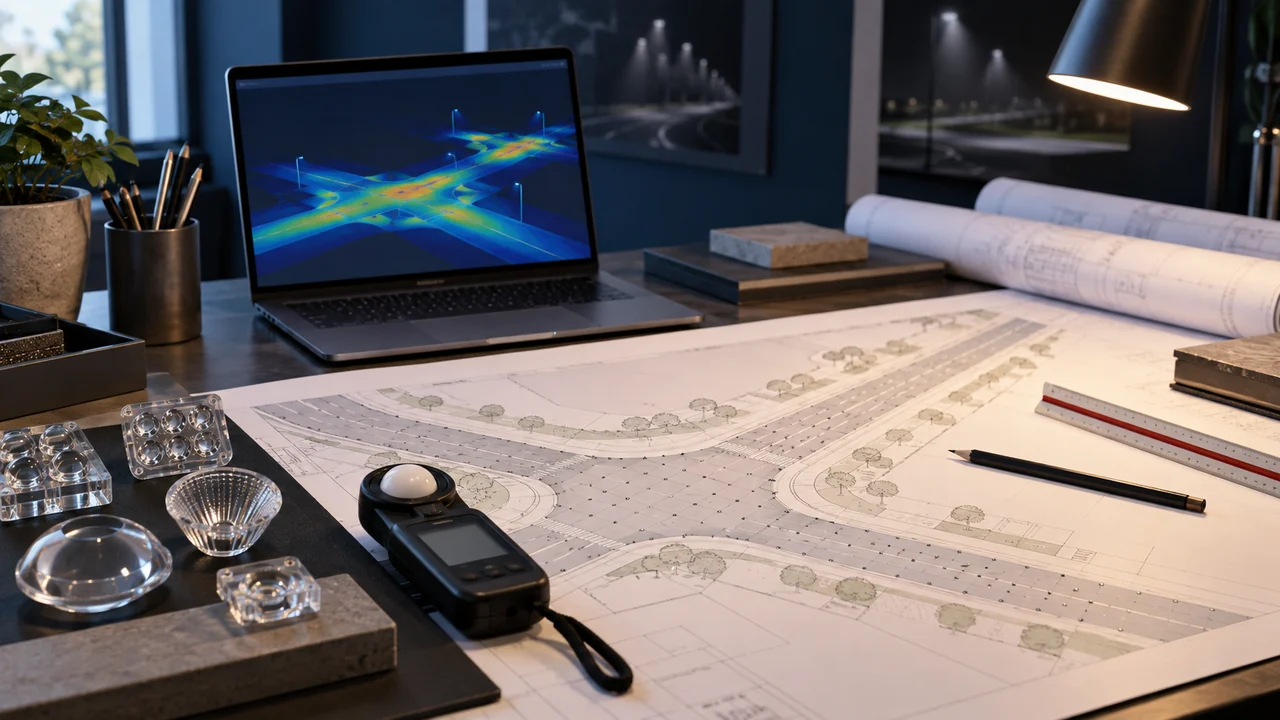
Studio illuminotecnico con planimetria, ottiche e simulazione della luce. Immagine illustrativa generata con AI.
Overview
In Italian public procurement, minimum environmental criteria are not an optional extra: they are mandatory requirements affecting tender admissibility and the documentation to be produced. In hotels, light builds the guest experience while supporting staff work and safety requirements. Here is how they translate into practice for hospitality lighting.
Applicable standards
The regulatory reference for hospitality lighting is not a single document but a coordinated set of standards covering performance, safety and environmental impact. In design practice the following documents drive the main choices.
EN 12464-1 — work areas, kitchens and back office.
EN 1838 — safety lighting in common areas.
EN 13201 — outdoor areas, access roads and car parks.
What becomes mandatory
The criteria are split into basic technical specifications, which are mandatory, and award criteria, which score points during evaluation. The former must be incorporated fully into the specification: their absence exposes the procedure to challenge. The latter should be calibrated on the real market, since overly restrictive award criteria reduce competition without improving quality.
Documentation and means of proof
Each criterion comes with admitted means of proof. The specification must reference them explicitly, stating which document satisfies which requirement: manufacturer declarations, test reports, datasheets and environmental documentation have different evidential value and are not interchangeable.
During tender assessment the committee must be able to trace every declaration back to a document it can consult. Preparing a requirement-to-document matrix during the tender phase shortens evaluation and reduces requests for clarification.
From contract to operation
Some criteria take effect after handover: spare-part availability, end-of-life management, disassembly information. They must be turned into verifiable contractual obligations, otherwise they remain statements of intent with no operational follow-up.
Recurring critical points
The difficulties that most often emerge in hospitality lighting projects are not about product selection, but about defining requirements and verifying results.
Separating atmosphere in guest areas from performance in service areas.
Managing evening and night scenarios without complicating staff operation.
Containing consumption in 24-hour facilities.
Design approach
An orderly method drastically reduces variations during works and disputes at commissioning. Three choices make the difference from the earliest stages.
Scheduled scenarios by time band with simplified controls.
Clear circuit separation between front and back of house.
Sensors and timers in intermittently occupied areas.
Parameters to verify
Service areas — EN 12464-1 — requirements from the visual task
Common areas — design — scenarios and lighting hierarchy
Safety — EN 1838 — corridors, stairs and exits
Outdoors — EN 13201 — access, internal roads and parking
Most frequent mistakes
Non-conformities found at commissioning almost always come from three causes: requirements not declared or declared without a reference standard, calculation run on idealised geometry, and an optimistic maintenance factor. All three can be avoided at zero cost during design.
Key takeaways
A hospitality lighting project holds up over time when requirements are declared, the calculation reproduces real conditions and on-site verification follows an agreed protocol. Component selection matters, but comes later: without measurable requirements even the best product delivers a result that cannot be demonstrated. Centro Studi Lumeitalia makes its technical office available to review requirements and design checks.
Methodological note: This content is written for technical information purposes by Centro Studi Lumeitalia and does not replace the lighting design or a full reading of the standards cited. Applicable performance values are those of the standards in force at design time.
Domande frequenti
How are hotel scenarios managed?+
With scheduled time profiles and few manual overrides: complexity should be hidden from staff, who need simple actions.
Which areas have strict regulatory requirements?+
Kitchens, laundries, offices and technical rooms follow EN 12464-1; corridors, stairs and exits require safety lighting per EN 1838.
Where should a hospitality lighting project start?+
From a written definition of performance requirements and verification conditions: this step drives every later choice and makes the result either disputable or defensible at commissioning.
Which documents should be requested from the supplier?+
Photometric files of the proposed luminaires, declaration of conformity, lifetime data declared per IES LM-80 with its conditions, the maintenance schedule and warranty terms.
Lumeitalia — Sistemi LED professionali
Lumeitalia è il brand di illuminazione LED professionale di Mya Tech S.r.l., azienda italiana fondata nel 2011 a Trezzano sul Naviglio (MI); il brand è attivo dal 2020.